Blue Eye Albania (Syri i Kaltër) 2026: entry fee, getting there from Saranda, best time – and why nobody knows how deep it is
22 Nov 2026 · 14 min read
In short: The Blue Eye (Syri i Kaltër) is a karst spring 22 km east of Saranda where ice-cold water pushes up out of a funnel nobody has reached the bottom of – divers got to about 50 metres. You pay 50 lek per person plus 200–300 lek for the car (cash only), walk 2 km on a flat forest track from the car park or take the little train, and you arrive before 9 am, before the coaches from Saranda and Corfu. Swimming is banned. Updated 11/2026, details and sources below.
It is 7:40 am and the track from the car park smells of wet leaves and plane-tree bark. On your left the Bistricë river rushes past, so clear you can count the pebbles, and the closer you get, the colder the air becomes – as if someone had opened a fridge door. Then you are standing on the wooden platform looking into an eye: turquoise on the outside like shallow Caribbean water, and in the middle a deep-blue, almost black circle about ten metres across in which the water visibly boils upwards. A leaf that falls in is pushed away before it can sink. Around you: three people. In two hours there will be three hundred.
Plan this tripOur go-to links for a place to stay, rental cars, mobile data and travel gear:
In this article: what makes the Blue Eye so unusual (and why nobody knows how deep it is), what entry, parking and the train cost in 2026, how to get there from Saranda, Ksamil or Gjirokastër – by car, bus or tour –, the best time of day and year, the honest downsides, what to combine it with, entry requirements, a checklist and FAQ.
Why the Blue Eye is a wow place
Syri i Kaltër lies near the village of Muzinë in the municipality of Finiq, at the foot of the Mali i Gjerë limestone massif between Saranda and Gjirokastër. It is the main source of the Bistricë river, which reaches the Ionian Sea near Saranda after roughly 25 km. The water stays at about 10 to 13 °C all year and comes up with enormous force: several sources quote around 18,400 litres per second, others “over 6 cubic metres per second” – the flow varies with rain and snowmelt in the karst, and no official continuous measurement has been published. Either figure means the same thing: more water leaves the mountain here in one second than a hundred bathtubs hold.
The eye itself is a vertical karst shaft. Divers have descended to about 50 metres without finding the bottom; the upwelling current pushes them back. That is why there is still no confirmed depth, and why the dark core looks so black: light simply does not reach it. The turquoise rim is the “iris” – shallow water over pale limestone. The spring is a protected natural monument; sources disagree on the size of the protected area (from a few hectares around the spring itself to almost 300 hectares of hillside above it). Downstream, a small hydro plant from the 1960s dams the Bistricë – the water that makes you shiver here produces electricity a few kilometres on. And it has one more property you only notice when you put your hand in.
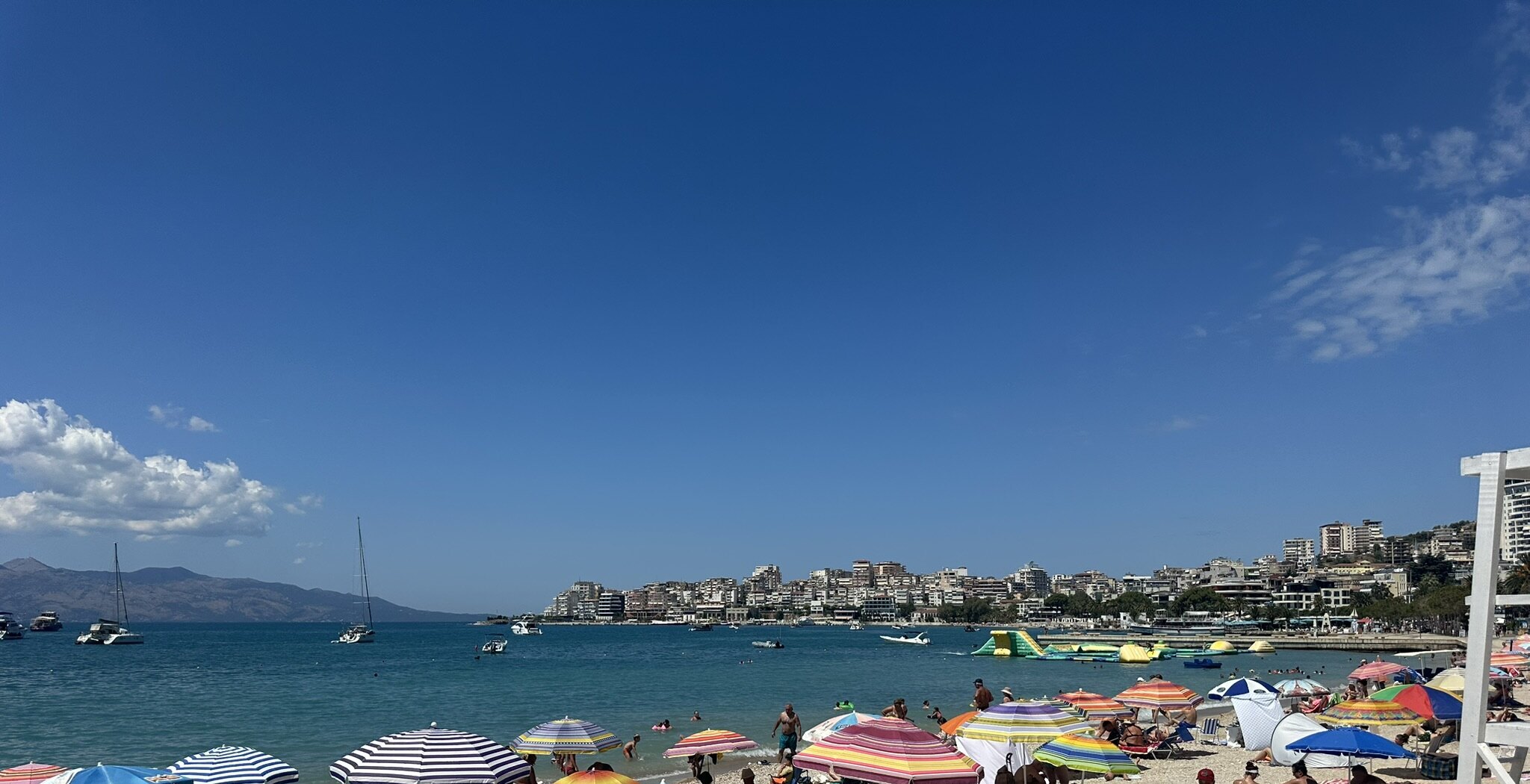
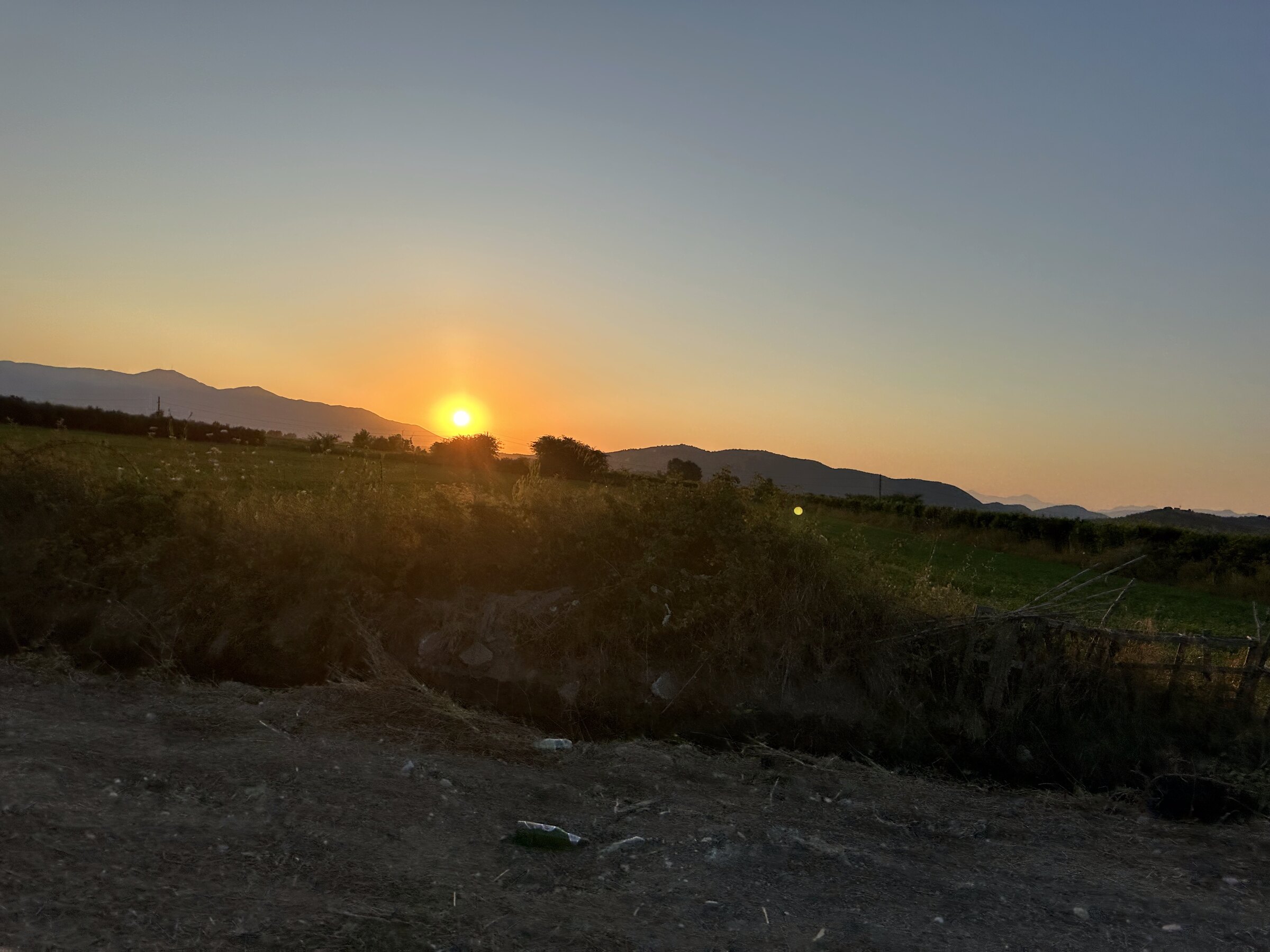
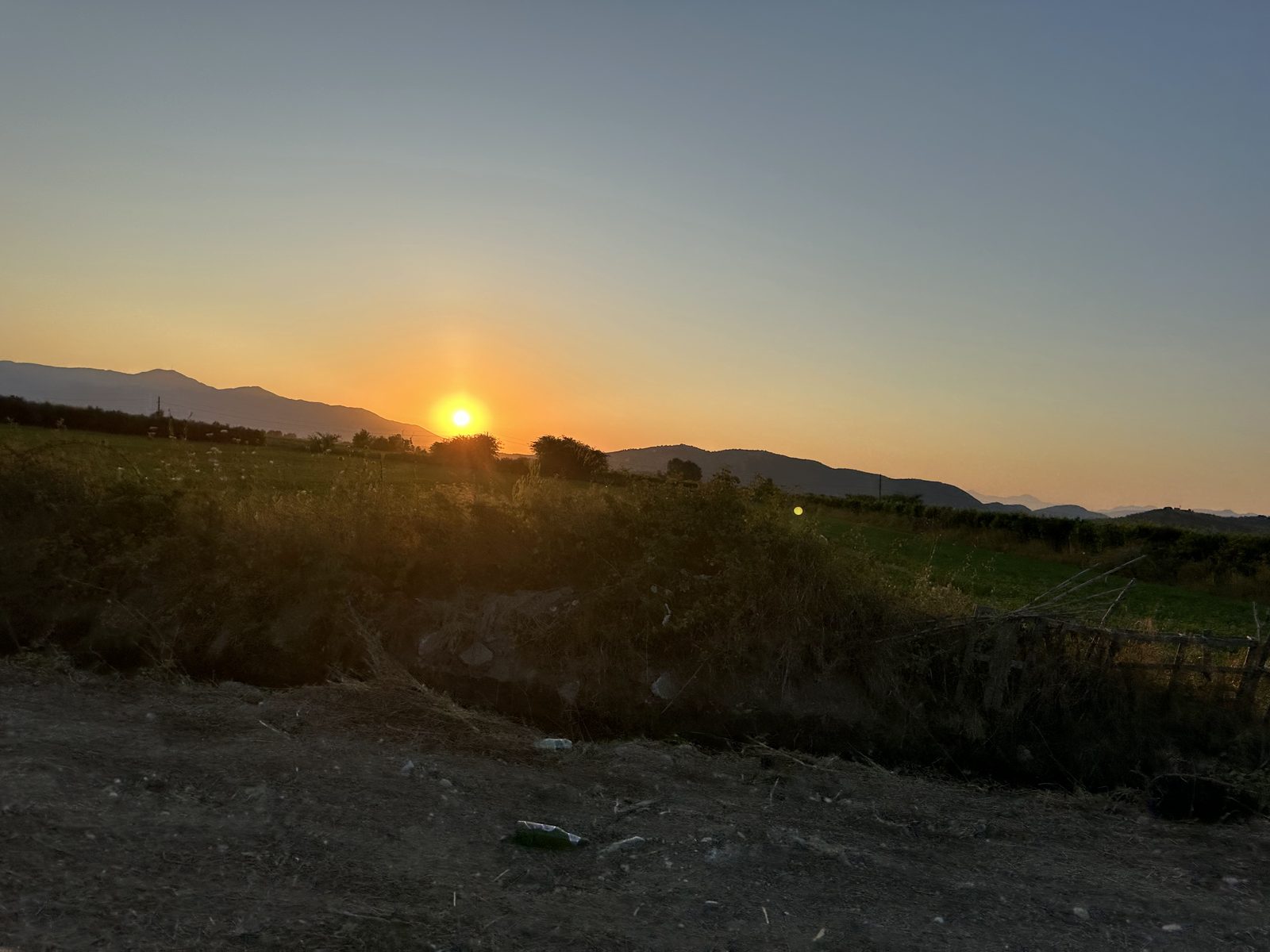
Your starting point: Saranda’s town beach and evening over the fields near Xarrë behind Ksamil – from here it is 30 to 60 minutes to the Blue Eye. Southern Albania, July 2025 (our own photos).
Entry, parking and the train: 2026 prices
The Blue Eye is not a national park with an online shop but a site with a barrier, a ticket hut and cash. The amounts are small, but you need them in lek – there is no ATM on site and cards are not accepted. Rule of thumb: 100 lek is roughly 1 euro (check the rate before you travel).
Item
Price 2026
Note
Entry
50 lek per person, cash
Several 2026 reports quote 50 lek; one blog quotes 100 lek. Children’s price: not published – ask at the hut.
Parking, car
200–300 lek, cash
Travellers report the barrier price rising from 200 to 300 lek (up to 3 hours) in 2026; minibus around 300 lek.
Parking, campervan
about 800 lek
Valid up to 24 hours – overnighting on the car park is tolerated, comfort is nil.
Little train car park → spring
about 300 lek one way / 600 lek return
Runs when full rather than to a timetable; often not at all in winter. E-scooters for hire as an alternative.
Opening hours
summer roughly 8 am–8 pm, winter 8 am–4 pm
Sources differ (some say 7 am–7 pm); off season the barrier is often simply open and nobody collects.
Sources: guidetoalbania.com (08/2026), himara.net (10/2026), ticrentcar.com (07/2026), albanianblogger.com (06/2026). For two people with a car, budget 300 to 400 lek, about 3 to 4 euros – for one of the most photographed places in Albania. It only gets expensive if you underestimate the walk between car park and spring.
From the car park to the spring: 2 km that are part of the visit
From the car park at the barrier a flat, shady track follows the river for a good 2 km to the spring – 20 to 25 minutes on foot, fine with a pushchair. In summer this is the most pleasant part of the visit: plane trees, the sound of water, cooler with every step. If you cannot or do not want to walk, take the little train or a rental scooter; both start at the car park. At the spring there is a wooden platform directly above the eye, a short loop along the bank, a restaurant with a terrace (prices well above Saranda level, quality fine) and benches by the river. None of our sources explicitly mentions toilets – go before you set off.
Allow 1 to 1.5 hours for the whole visit including the walk. Hardly anyone stays longer, because you have seen the eye itself in ten minutes; what makes the difference is when you have those ten minutes. More on that below. First, how to get there at all.
Getting there from Saranda, Ksamil and Gjirokastër: car, bus or tour
The Blue Eye sits right on the SH99, the road from Saranda over the pass to Gjirokastër. By your own or a rented car it is easiest; by public bus you have to walk; by organised tour you arrive at the busiest time.
From
Distance / time
How
Saranda (car)
22 km, 30–40 min
SH99 towards Gjirokastër, turn-off signposted “Syri i Kaltër” near Muzinë. Winding, oncoming coaches in summer.
Ksamil (car)
about 34 km, about 1 h
Via Saranda; leave early to beat the town traffic.
Gjirokastër (car)
about 37 km, 45–50 min
Over the Mali i Gjerë pass, a scenic road with views into the Drino valley. Ideal stop between the stone city and the coast.
Tirana (car)
about 280 km, about 4 h
Only sensible as a leg of a road trip, not as a day trip.
Public bus Saranda–Gjirokastër
about 30 min to the junction
No bus goes to the entrance. You get off on the main road and walk about 2 km to the car park plus 2 km to the spring. Going back you wait at the roadside for the next bus – only with a time buffer and water.
Taxi from Saranda
30–40 min
Agree the price and the waiting time in advance (there and back plus 1.5 hours on site), or you may be left without a ride home.
Day tour from Saranda or Corfu
half or full day
Usually combined with Butrint or Gjirokastër. Check whether entry, parking and the train are included; the coaches arrive between 10 am and 3 pm – the busiest time.
Compare flights to Corfu (then the ferry to Saranda) or to Tirana on Kiwi.com (ad). How to reach the coast in the first place and where to sleep is in our comparison Albanian Riviera: Ksamil, Saranda, Himara and Dhërmi; the full loop through the country with the Blue Eye as day 5 is in Albania road trip in 10 days. All prices and routes of the south are also collected in our guide “Roadtrip Balkan & Griechenland” (in German) – with the official entry links as QR codes. That leaves the most important decision of the day: the time.
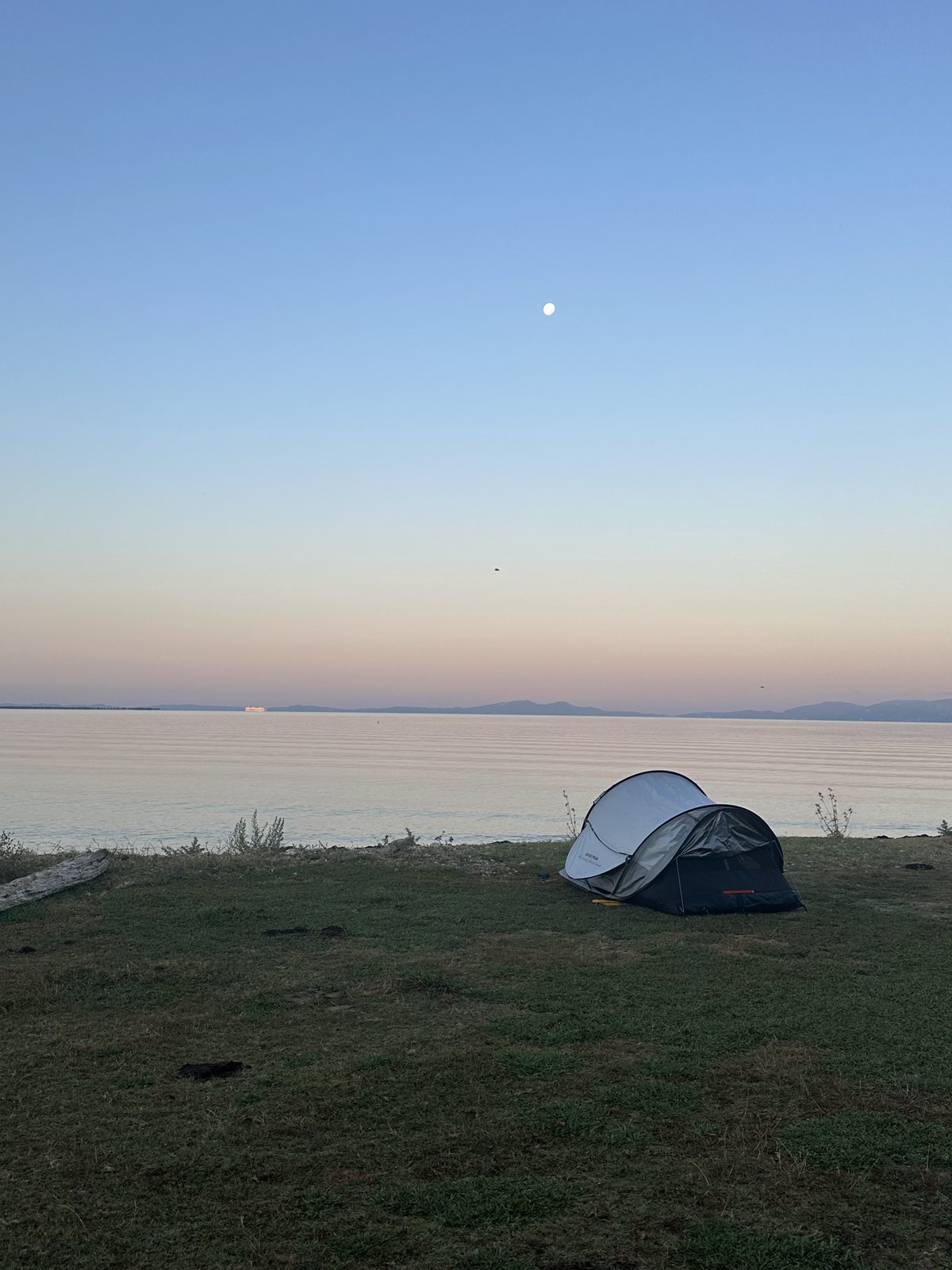
Our tent on the beach at sunrise and the hinterland between coast and mountains in the evening – get up this early and you are at the spring before everyone else. Southern Albania, July 2025 (our own photos).
Best time of day and year
The rule is simple: before 9 am or after 4 pm. From about 10 am the coaches from Saranda arrive, in summer joined by day-trippers off the Corfu ferry, and between 10 am and 3 pm hundreds of people stand around a pool ten metres across. In July and August the car park is sometimes full before 9 am and the SH99 jams with oncoming traffic. Early in the morning, by contrast, you get what the photos promise: silence, mist over the river, water that really is black in the middle.
For the light: the blue glows most when the sun is high and falls straight into the water – which is exactly when it is busiest. The compromise in summer is 8:30 to 9:30 am: light already in the eye, still room on the platform. The best months are May, June and September: warm enough for the coast, the spring strong from snowmelt, fewer coaches. In winter you can often visit with no ticket hut and no train, but with short opening hours and an occasionally snowed-in pass. And then there are the points that never appear in an Instagram reel.
The honest downsides
First: swimming is banned. Signs are up, guards enforce it, and the photos of people jumping into the funnel date from before the rule. The water is 10 °C, the upwelling in the middle is strong, and the bank is a protected zone – jump anyway and you risk a fine and cold shock. Dipping your feet in the riverbed a little below the spring is usually tolerated; nothing more. Second: the eye is small. If you expect a national-park day, you are done after an hour – plan it as a stop between Gjirokastër and the coast, not as a destination in itself. Third: cash only, and the prices at the barrier change without notice – ask for a receipt for parking and entry. Fourth: in the midday heat the car park is full, the track is noisy and the platform is a selfie queue. Know these four points and you will not be disappointed – and you can pair the visit with two places that make the day complete.
What to combine with the Blue Eye
The classic loop from Saranda: leave at 7:30 am, spring at 8:15, on over the pass at 10 to Gjirokastër – UNESCO World Heritage, stone houses with slate roofs, the castle with its military museum (400 lek, 2026) and the bazaar for a late lunch. Back on the coast you catch sunset at Lekurësi Castle above Saranda, looking across to Corfu. Or turn it round: Butrint at opening time in the morning (1,000 lek, 2–3 hours for the loop), then the spring in the late afternoon once the coaches have gone. Butrint’s entry fees, hours and buses are in the Riviera comparison; what else the country has to offer – from Berat to Theth – is in Albania: things to do. And if the hinterland gets under your skin: the 40-day drive through the Balkans and Greece that brought us to this coast in 2025 is in Balkans and Greece road trip. But first, what comes with a non-EU border.
Entry & visa – official sites only
Albania is neither an EU nor a Schengen member. EU and UK citizens, and many others including US, Canadian and Australian passport holders, enter visa-free – for most nationalities up to 90 days in any 180; check your own case on the ministry page below. EU citizens may also use a national ID card. The document must still be valid on departure – Austria’s foreign ministry recommends three months’ validity. With your own car you need the Green Card with “AL” listed. On re-entering the EU (Greece, or Croatia via Montenegro), non-EU citizens are subject to the EES and – once it is running – ETIAS; EU citizens are not affected.
Albanian Ministry for Europe and Foreign Affairs (visas, entry): punetejashtme.gov.al
Albanian State Police (border crossings, waiting times): asp.gov.al
Austrian Foreign Ministry, travel information Albania (German): bmeia.gv.at
EU – EES and ETIAS for non-EU citizens: travel-europe.europa.eu
Safely to the official site: we deliberately don’t link entry portals here – fake sites look real and charge several times the official fee (it happened to us). The right way, with a QR code straight to the official site, is in our travel guide.
Warning about intermediary sites: There is no e-visa and no online registration for Albania for visa-free travellers – anyone selling you one is charging you for nothing. The Blue Eye itself needs no online ticket either; sites offering “skip-the-line tickets” for the spring are at best selling you a coach tour. For Corfu–Saranda ferry tickets and the neighbouring countries’ motorway vignettes, resellers charging several times the price come first in search results; we fell for one of those vignette sites ourselves. Since then: official sites only, type the address yourself, never click an ad. In our guide you will find all official links as QR codes.
Checklist: the Blue Eye in a morning
☐ Leave Saranda by 7:30 am at the latest (July/August: 7 am), Ksamil 30 minutes earlier
☐ 400–500 lek per person in small notes: entry, parking, train, coffee
☐ Sturdy sandals or trainers – 2 km of gravel and boardwalk, no flip-flops
☐ Light jacket or scarf: it is 5–10 degrees cooler at the spring than in Saranda
☐ Water and a snack; treat the restaurant as a coffee stop only
☐ No swimming, no jumping, nothing thrown in – protected area
☐ Gjirokastër or Butrint planned for the rest of the day, back for sunset at Lekurësi
☐ Passport/ID with 3 months’ validity, Green Card with “AL” in the car
50 lek entry per person plus 200 to 300 lek for car parking, campervans around 800 lek, all cash only (updated 11/2026, several 2026 traveller reports). The little train from the car park to the spring costs about 300 lek one way. A visit for two with a car works out at 3 to 4 euros.
Can you swim in the Blue Eye?
No. Swimming and jumping are banned, with signs and guards on site; the water is about 10 °C all year and the upwelling in the funnel is strong. Dipping your feet in the riverbed a little downstream is usually tolerated.
How deep is the Blue Eye?
Nobody knows exactly. Divers have reached about 50 metres and were pushed back by the rising water without seeing the bottom. There is no officially confirmed depth.
How do I get to the Blue Eye without a car?
Take the Saranda–Gjirokastër bus to the junction on the SH99 and walk about 4 km (2 km to the car park, 2 km to the spring), take a taxi with an agreed waiting time, or join a day tour from Saranda or Corfu. There is no bus to the entrance.
What is the best time to visit the Blue Eye?
Before 9 am or after 4 pm. Between 10 am and 3 pm the coaches from Saranda and the Corfu day-trippers are there. The best months are May, June and September; in July and August the car park is often full early.
How long do you need at the Blue Eye?
1 to 1.5 hours including the 2 km walk each way. Plan it as a stop between Gjirokastër and Saranda or together with Butrint, not as a destination on its own.
Sources: guidetoalbania.com – The Blue Eye: What Changed, and How to Visit It Properly (8 Aug 2026); himara.net – Blue Eye Albania: Tickets, Access & Honest Review (updated 10 Oct 2026); ticrentcar.com – Blue Eye Albania 2026: Driving, Parking & Entrance Fees (updated 24 Jul 2026); albaniabynomadays.com – Blue Eye Spring practical guide (12 May 2026); albanianblogger.com – Blue Eye Albania, Local’s Guide (29 Jun 2026); Austrian Foreign Ministry (BMEIA) travel information Albania (retrieved 21 Nov 2026); our own trip through southern Albania in July 2025 (Vlorë, Himara coast, Saranda, Ksamil – the spring itself is described from research, not from our own visit). All information as of 11/2026 – prices and hours at the barrier can change without notice.
Plan this tripOur go-to links for a place to stay, rental cars, mobile data and travel gear:
🔔 Get new articles & deals as a notification?No spam – max. 4 a day, switch off anytime.
Your choice
We only use what is necessary to run this website. Everything else – such as statistics or content from third parties – only with your consent. You can change your choice at any time.