Lofoten Costs in Winter 2026/27: What the Trip Really Costs – and Where You Save Thousands of Kroner
19 Nov 2026 · 15 min read
Quick answer: Lofoten costs in winter come down to four big blocks: flights, rental car, accommodation and food. These items are fixed and verifiable: the car ferry Bodø–Moskenes costs 605 NOK for a car up to 6 m according to Torghatten, and without a vehicle you travel free if you don’t reserve a seat. Diesel averaged 27.26 NOK per litre in October 2026 according to Statistics Norway (SSB), petrol 25.67 NOK. The Lofotr Viking Museum charges 210 NOK for adults until 31 Dec 2026. Restaurants and hotels in Norway are about 40% more expensive than the EU average, groceries about 31% (SSB). New: Vågan (Svolvær, Henningsvær) may charge a visitor levy from 1 January 2027. Your biggest saving: self-catering and skipping northern lights tours – on Lofoten you often see the lights right from your cabin. Checked 19.11.2026, sources below.
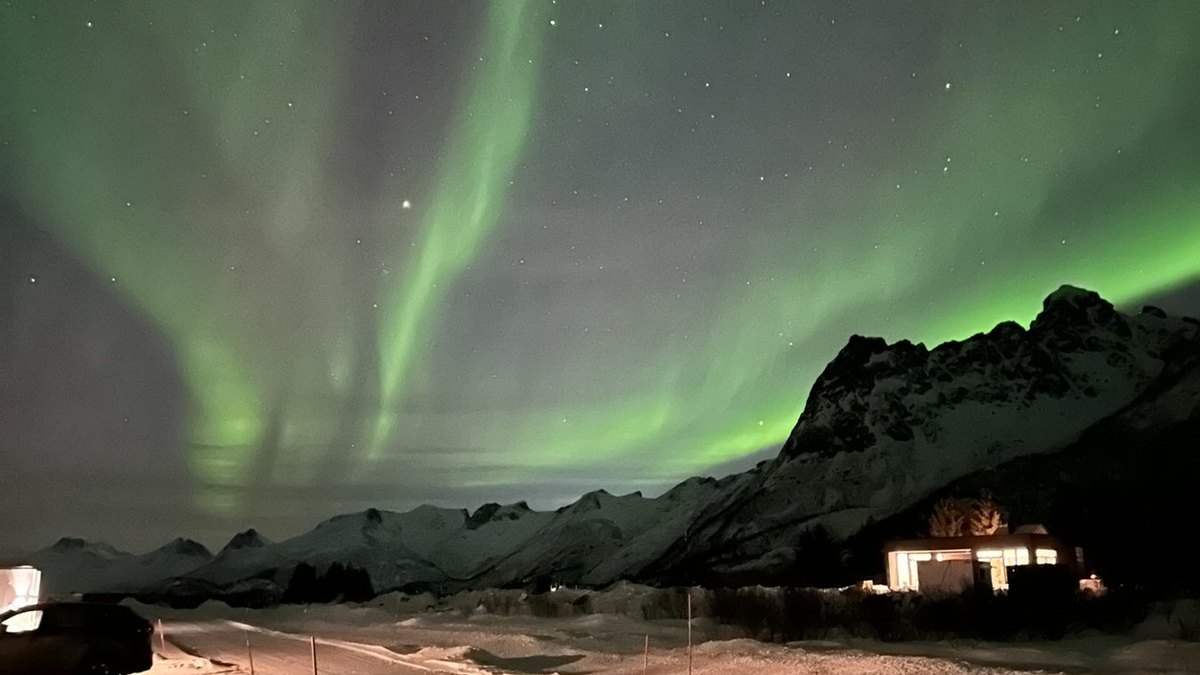
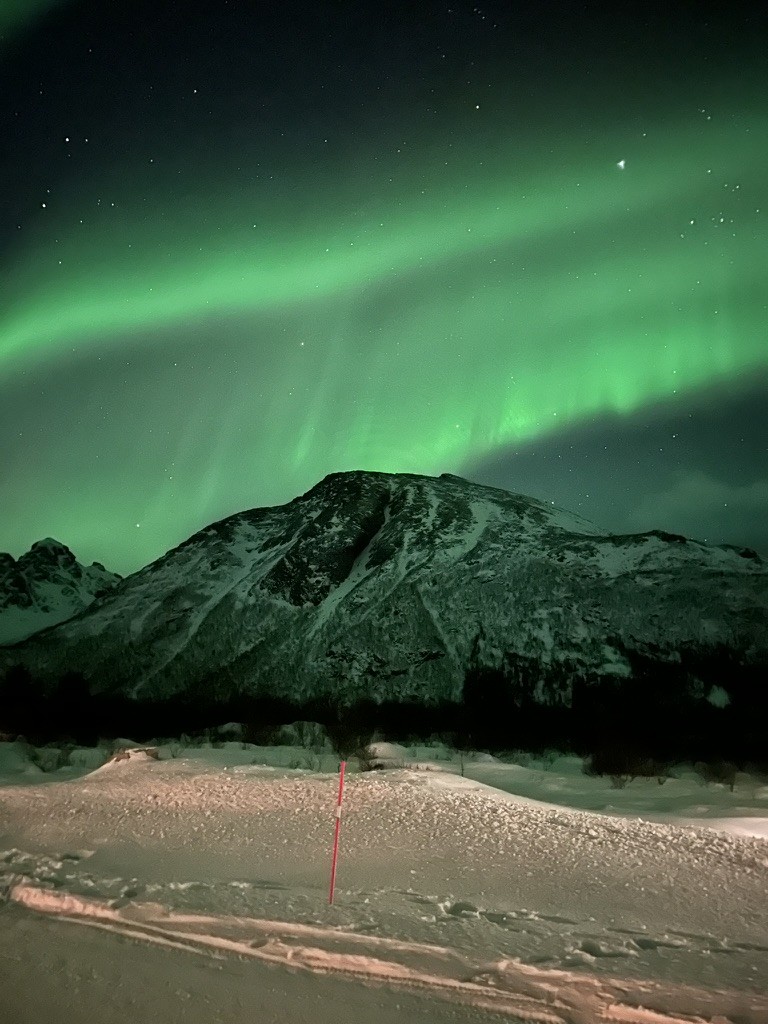
It’s just after six in the evening, a few degrees below zero, snow crunching under your boots. You’re standing in front of a red fisherman’s cabin, the fjord is black as ink – and then the sky starts to dance. Green, then a hint of violet, ribbons draping over the peaks. No bus full of strangers, no guide, no ticket. Just you, a flask of tea and a light you will never forget.
📘Our Norway winter guide as a PDF: route, costs, packing list and our links€9.90 PDF · English + German in one purchase · instant downloadBuy now – €9.90 →
Plan this tripOur go-to links for a place to stay, rental cars, mobile data and travel gear:
That’s exactly how we experienced it: from 20 December 2024 to 6 January 2025 we drove a rental car through Northern Norway, across Lofoten and up to Tromsø, in the middle of the polar night. On Lofoten we saw the northern lights almost every evening, mostly between 6 and 9 pm. And we learned where Norway is expensive – and where a little planning saves you a lot. This post works out Lofoten costs in winter honestly, using only figures we checked with official sources on 19.11.2026. Where there are no reliable averages (rental cars, rorbu cabins), we say so and show you how to compare yourself.
Northern lights over the mountains – seen on our own, no tour. Our own photo from our road trip through Northern Norway (December/January).
Lofoten costs in winter: the overview
Before we go through each item, here is everything we can back up with a source – and what you need to compare yourself on the day:
free without reservation; reserved seat 65 NOK (child 35 NOK)
Torghatten (19.11.2026)
Diesel / petrol 95
27.26 / 25.67 NOK per litre (October 2026 average)
SSB fuel price statistics (updated 19.11.2026)
Lofotr Viking Museum
adult 210 NOK, child 160 NOK, family 620 NOK
Museum Nord, valid 16.09.–31.12.2026
Norway price level
+24% overall, restaurants/hotels +40%, food +31% (vs. EU average)
SSB, 2024 data, published 20.06.2025
Visitor levy (besøksbidrag)
in Vågan from 1.1.2027 at the earliest, rate not yet published
Norwegian Ministry of Trade, 28.10.2026
Guided northern lights tour (Tromsø example)
1,295 NOK per person
VisitTromsø, as of 24.10.2026
Rental car, rorbu, hotel
vary a lot – compare yourself
see sections below
A word on exchange rates: we deliberately calculate in Norwegian kroner (NOK) here, because the rate keeps moving. Always pay in kroner in Norway, never in euros or pounds – more on that under the traps below.
Getting there: flight or ferry – what drives Lofoten costs
Lofoten has small airports of its own, such as Leknes, which according to Store norske leksikon is run by Avinor and served by Widerøe. Many travellers fly into Harstad/Narvik (Evenes) instead and drive about 2.5 hours to Svolvær – that’s how we planned our Lofoten winter road trip. The upside: more rental cars and often better flight connections. The downside: more kilometres, more fuel.
The Bodø–Moskenes ferry is the other classic route. Torghatten charges 605 NOK for a car up to 6 m, 1,302 NOK for 6–8 m and 177 NOK for a motorbike. Travelling without a vehicle and without a reserved spot is free; a reserved spot costs 65 NOK per adult and 35 NOK per child. Only part of the capacity can be reserved, by 8 pm the day before; booked travellers must be at the port at least 45 minutes before departure. Winter weather can shift sailings – always plan a buffer day.
Hurtigruten and Havila list Svolvær and Stamsund among their ports. For most winter travellers, that’s more of an experience than a budget way to arrive.
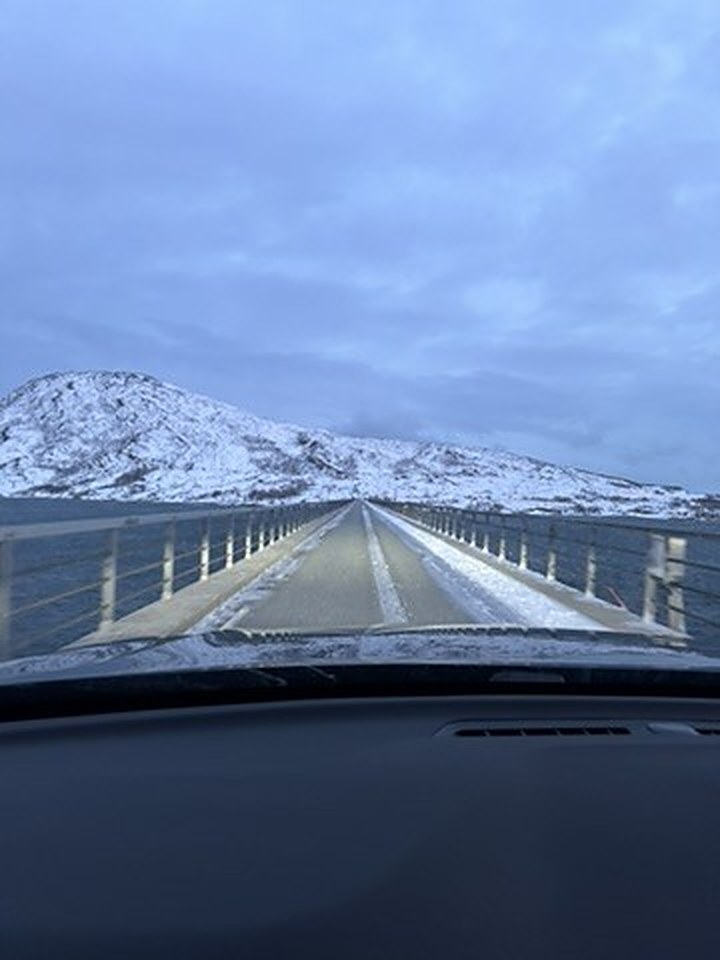
On the road with our rental car across one of the many bridges – our own photo from Northern Norway.
Planning this trip?Norway in winter: Lofoten, Alta, Tromsø
Day by day from our 18 days of polar night – with our own photos and route variants
Tromsø or Lofoten, daily costs, QR codes to Google Maps, budget planner with checked prices
Entry via official links only, emergency page with embassies – plus travelling with a dog
In winter a car is almost essential on Lofoten if you want to chase the northern lights flexibly and see the villages between Svolvær and Å. According to Visit Lofoten, Fiskebøl to Å is 163 km, all without a ferry.
We deliberately don’t quote an average rental price. It depends heavily on the week, pick-up point and car class – around Christmas and New Year, supply at Evenes and Leknes is tight. Compare early, for example on Discover Cars (advertising), and check these three points:
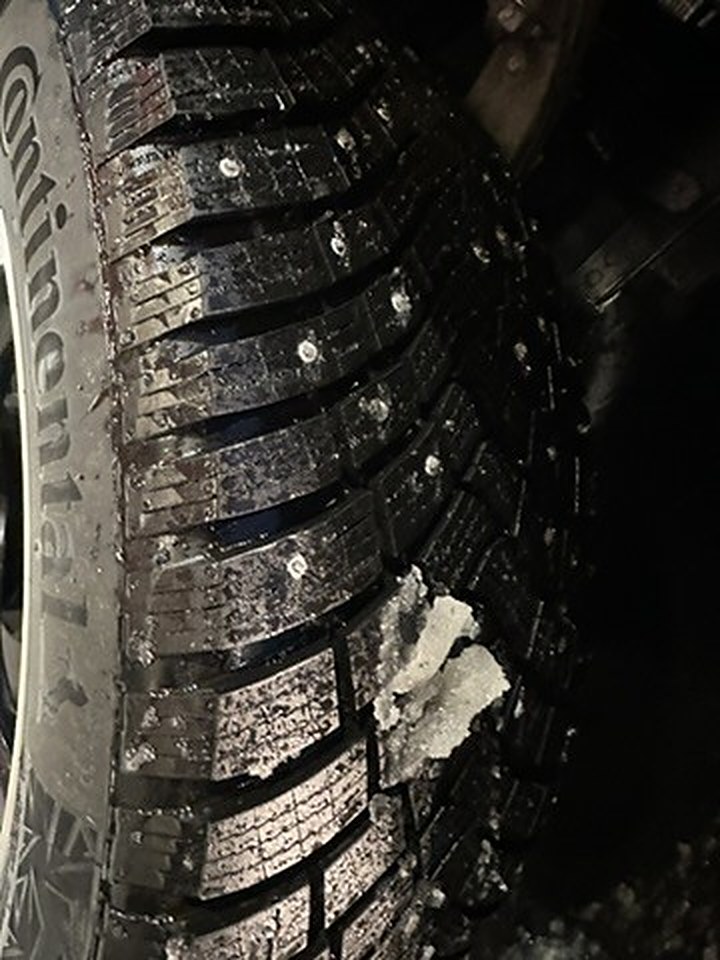
Studded tyres: in Nordland, studs are allowed from 16 October to 30 April according to the Norwegian Public Roads Administration, with at least 3 mm tread in the winter period. The driver is responsible for adequate grip – weather and road conditions override any date. Ask explicitly for studded tyres; we had them and were grateful on the ice every single day.
Tolls: rental companies often charge tolls via an in-car device, frequently with a daily fee plus the actual tolls. Read the terms before you book.
Excess: stone chips and scratches on icy car parks are common in winter. Check the excess and photograph the car all round at pick-up.
Fuel example (our own calculation): if you drive 1,000 km in a week in a car using 7 litres of diesel per 100 km, that’s 70 litres. At the SSB October 2026 average (27.26 NOK) that comes to about 1,908 NOK. If you only drive the 163 km Fiskebøl–Å and back plus detours, it’s correspondingly less. Cutting unnecessary long stages saves the most – on our trip we dropped exactly such a stage, which had cost us days and fuel.
Always ask: studded tyres on the rental car. Our own photo from the road.
Accommodation: rorbu, hotel or cabin – what a night costs
The classic Lofoten stay is a rorbu, a former fisherman’s cabin by the water, usually painted red and built on stilts. There are also hotels in Svolvær and Leknes, holiday homes and Airbnb flats. Again, we won’t invent average prices: what a night costs depends hugely on location, size and dates. What we can say for sure:
Self-catering saves the most: almost all rorbuer and cabins have a kitchen. According to SSB, restaurant and hotel prices in Norway are about 40% above the EU average – cooking your own dinner saves noticeably every day.
Location beats luxury: a place with a clear view north and little street light is gold in winter. On Lofoten we often saw the northern lights from the window.
Christmas and New Year book up early. If you’re flexible, January and February offer more choice.
Visitor levy from 2027: on 28.10.2026 the Norwegian Ministry of Trade approved Vågan’s plan (incl. Svolvær, Henningsvær, Kabelvåg) for an overnight levy. It can be charged from 1 January 2027 at the earliest; the rate had not been published as of 19.11.2026. Flakstad, Moskenes, Vestvågøy, Røst and Værøy have filed a joint application that is still being processed.
Compare places to stay: Booking.com for rorbuer and hotels, Airbnb for cabins with a kitchen (both advertising).
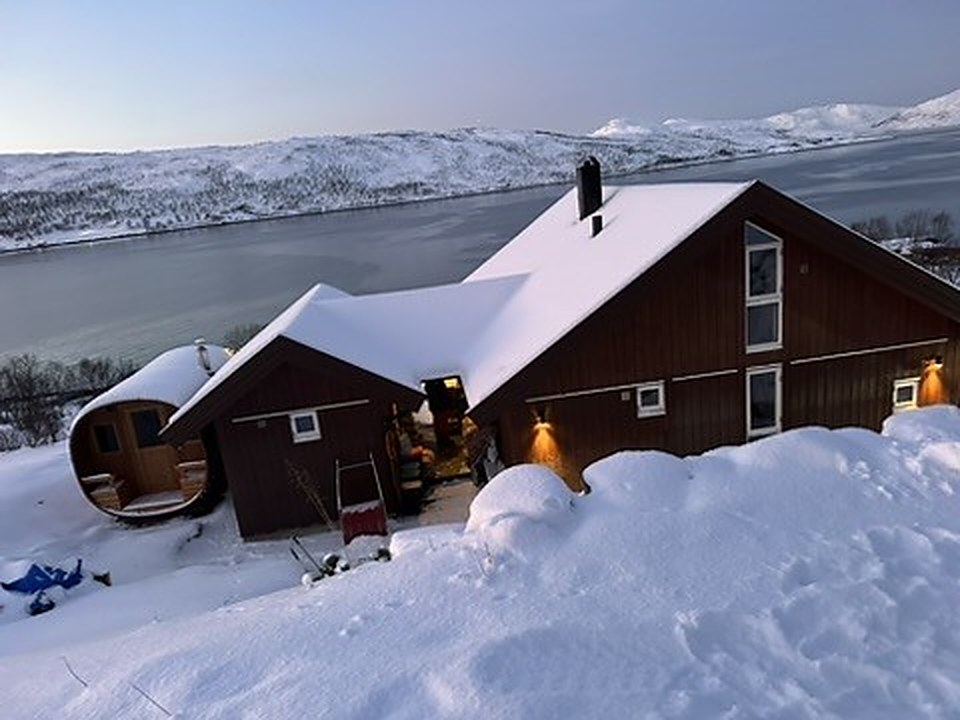
A cabin with a kitchen and fjord views – the way to save on dinner in Norway. Our own photo from Northern Norway.
Food on Lofoten: supermarket over restaurant
Norway is expensive, and on the islands you feel it most at mealtimes. According to SSB, food and non-alcoholic drinks were about 31% above the EU average in 2024, restaurants and hotels about 40%. Our honest advice:
Big shop before heading west: Svolvær and Leknes have large supermarkets. In the west (Reine, Å) choice is smaller, and in winter many shops and cafés have shorter hours or are closed.
Eat out for fish once: stockfish and fresh cod are part of Lofoten. Treat yourself to one good dinner – and cook on the other days.
Alcohol: wine and spirits are sold only at the state-run Vinmonopolet with limited hours, and beer in supermarkets only at set times. If you’d like a glass in the evening, plan ahead.
Flask and snacks: for northern lights evenings in the car – saves a café stop every night, and in winter the cafés are often closed anyway.
Activities: what really costs money – and what’s free
The beauty of Lofoten in winter: the greatest experiences cost nothing. The fishing villages of Hamnøy, Reine and Henningsvær, the beaches of Uttakleiv and Haukland, the bridges and fjords – all free to visit. More in our Lofoten things to do.
Paid: the Lofotr Viking Museum at Borg costs 210 NOK for adults, 160 NOK for children (6–15) and 620 NOK for a family (2 adults + 3 children), valid 16.09.–31.12.2026 according to Museum Nord. In November and December it opens only on Wednesdays and Saturdays, 11 am–5 pm, and is closed on 26 December. Check before you drive.
Guided tours (fjord safari, snowshoeing, photography) are on GetYourGuide (advertising). Read the cancellation terms – in winter, tours are cancelled for weather more often.
Northern lights tours: your biggest saving. A guided northern lights tour in Tromsø cost 1,295 NOK per person according to VisitTromsø (as of 24.10.2026). The calculation from our guide: 1,295 NOK × 2 people × 3 evenings = 7,770 NOK. On Lofoten you usually don’t need these tours: we saw the lights almost every evening there without one. In Tromsø we barely saw anything – there, a tour that chases gaps in the clouds can be worth it. The full comparison is in Tromsø or Lofoten.
Everything on a few pagesNorway in winter: Lofoten, Alta, Tromsø
Day by day from our 18 days of polar night – with our own photos and route variants
Tromsø or Lofoten, daily costs, QR codes to Google Maps, budget planner with checked prices
Entry via official links only, emergency page with embassies – plus travelling with a dog
Lofoten costs in winter: daylight is your hidden budget
What many underestimate: in winter you don’t just spend money, you spend light. According to timeanddate, the sun doesn’t rise at all in Svolvær from 7 December 2026 to 5 January 2027 (polar night). On 21 December there is only twilight from about 09:24 to 14:35. By 1 February 2027 there are 5 hours 46 minutes of daylight, by 21 February 8 hours 38 minutes. At the end of December we had usable light only from roughly 10 am to 2 pm.
What that means for your budget: travelling in December, you need more days for the same route – so more nights and more rental days. In February you cover more ground in fewer days, and your northern lights chances on dark, clear nights remain good. For photographers with limited leave, late January to February often gives the best value.
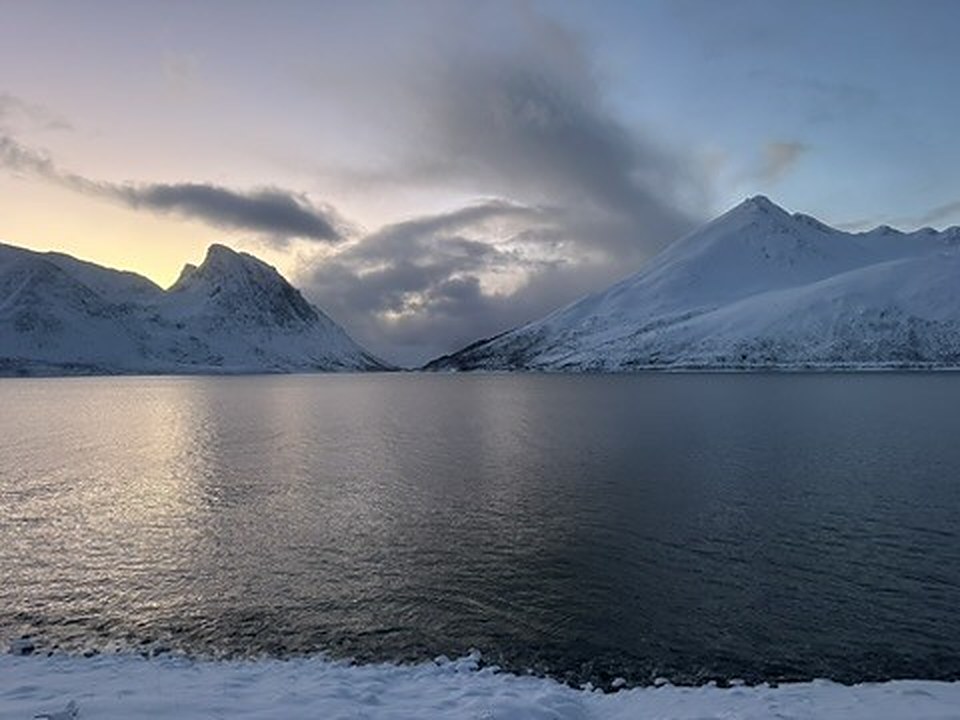
What “noon” looks like in the polar night: blue light over the fjord. Our own photo from Northern Norway.
Sample budget: how to plan your Lofoten costs
Instead of giving you made-up totals, here is the calculation we do before every Norway trip. Plug in your own quotes and you’ll instantly see where the money goes:
Block
How to calculate
Saving tip
Flights
return to Evenes, Leknes or Bodø (your quote)
Evenes often has more choice, but more driving
Rental car
daily rate × days + excess cover + toll device
book early, get studded tyres confirmed
Fuel
km ÷ 100 × consumption × 27.26 NOK (diesel, Oct 2026)
no unnecessary long stages
Ferry
605 NOK per crossing (car up to 6 m), if via Bodø
free without a car
Accommodation
nights × rate + possible visitor levy from 2027 (Vågan)
cabin with kitchen, north-facing view
Food
supermarket + 1–2 restaurant evenings
big shop in Svolvær/Leknes
Experiences
Lofotr 210 NOK + chosen tours
hunt the lights yourself instead of a tour
The most expensive traps for Lofoten costs
1. Paying in euros or pounds instead of kroner: if the card terminal asks “EUR or NOK?”, always choose NOK. In your home currency, the terminal uses its own, usually worse rate (dynamic currency conversion). With a card without foreign-exchange fees such as Wise (advertising) you pay the real rate. More in Money abroad.
2. Rental car without studs: cheap to book, expensive in the end – at worst with an accident or days you can’t drive.
3. Long daily stages in the polar night: cost days, fuel and nerves. Fewer places, in daylight.
4. Stopping on the E10 for photos: the road is narrow and lay-bys are often snowed in. Only stop at proper parking areas.
5. Booking a northern lights tour every night: often unnecessary on Lofoten – easily saves several thousand kroner.
6. Not checking opening hours: in winter many cafés, museums and shops have shorter hours or close. Check before each drive.
7. No buffer day: ferries and flights can be cancelled by weather in winter. A buffer day is cheaper than a missed flight home.
Our recommendations for Lofoten in winter (advertising – we earn a small commission at no extra cost to you):
Travel medical insurance: SafetyWing · Mobile data: eSIM · Pay in kroner without mark-up: Wise card
Warm gear (shoe spikes, head torch, flask): on Amazon
Checklist: Lofoten costs in winter under control
☐ Travel time chosen: December for Christmas mood, February for more light per day
☐ Airports compared: Evenes, Leknes or Bodø plus ferry
☐ Rental car booked early, studded tyres confirmed in writing, toll terms read
☐ Fuel calculated (km × consumption × 27.26 NOK)
☐ Accommodation with kitchen and north-facing view
☐ Big shop in Svolvær or Leknes planned
☐ Lofotr opening days checked (Nov/Dec Wed and Sat only)
☐ Card without FX fees, always pay in NOK
☐ Buffer day for weather, ferry and flight
☐ Flask, head torch and shoe spikes for northern lights evenings
💡Prefer it all offline? The Norway in winter: Lofoten, Alta, Tromsø guide has the essentials on a few pages.Buy now – €9.90 →
FAQ: Lofoten costs
How expensive is Lofoten in winter?
According to SSB, Norway’s price level is about 24% above the EU average, and about 40% for restaurants and hotels. The biggest items are flights, rental car and accommodation. Self-catering and skipping northern lights tours cut costs considerably.
How much is the Bodø–Moskenes ferry?
According to Torghatten, 605 NOK for a car up to 6 m, 1,302 NOK for 6–8 m and 177 NOK for a motorbike. Without a vehicle and without a reservation the crossing is free; a reserved spot costs 65 NOK (child 35 NOK).
How much is diesel in Norway?
According to Statistics Norway, the average price in October 2026 was 27.26 NOK per litre of diesel and 25.67 NOK per litre of petrol 95, including taxes.
Is there a tourist tax on Lofoten?
From 2027 there may be: the municipality of Vågan may charge an overnight levy from 1 January 2027 at the earliest, according to the ministry. The rate had not been published on 19.11.2026. Other Lofoten municipalities are still awaiting a decision.
Do I need a rental car on Lofoten?
In winter it’s almost essential if you want flexibility and to hunt the northern lights yourself. Make sure it has studded tyres and enough tread.
Is a northern lights tour on Lofoten worth it?
Usually not. We saw the northern lights almost every evening on Lofoten without a tour. Tours are more worthwhile in places with lots of city light or changeable weather, like Tromsø.
When is the cheapest time for Lofoten in winter?
Outside Christmas and New Year. In February you also have much more daylight (according to timeanddate over 8.5 hours in Svolvær on 21 February), so you cover more in fewer days.
Can I pay by card on Lofoten?
Yes, card payment is the norm in Norway. Always pay in kroner and use a card without foreign-exchange fees.
Bottom line: Lofoten is expensive – but the best part is free
Yes, Lofoten costs in winter are no bargain. Flights, rental car and accommodation add up, and a restaurant dinner costs noticeably more than at home. But what you really come for – northern lights over red cabins, mountains rising from the sea, the blue hour at lunchtime – doesn’t cost a single krone. Plan smart, cook for yourself, skip the tours you don’t need here, and spend the money on one extra day instead. We’d do it exactly like this again.
🔔 Get new articles & deals as a notification?No spam – max. 4 a day, switch off anytime.
Your choice
We only use what is necessary to run this website. Everything else – such as statistics or content from third parties – only with your consent. You can change your choice at any time.