Wat Arun Bangkok 2026: Entrance Fee 200 Baht, Ferry from Tha Tien, Best Time – and Why the Temple Is Made of Porcelain Shards
22 Nov 2026 · 14 min read
In short: Wat Arun, the Temple of Dawn, stands on the west bank of the Chao Phraya opposite Wat Pho. Foreign visitors pay 200 baht (about US$6, Thais free); it is open daily 8:00–18:00, last entry around 17:30. The easiest way in is the express boat to Tha Tien pier (N8) and the cross-river ferry for 3–5 baht – a two-minute ride. Shoulders and knees must be covered (sarongs at the gate against a deposit), and you may climb the central tower only to the first terrace. Best time: 8–10 a.m. inside, sunset from the opposite bank. As of 11/2026, sources below.
It is 7:55 a.m. at Tha Tien pier and the air smells of diesel, river water and grilled pork from the stall by the gate. The little ferry rocks, the engine coughs, and then it pulls away from the jetty – and for two minutes you own the widest view Bangkok has: brown water, a sand barge, and ahead of you a tower growing out of the bank that looks white from afar and sparkles up close, because it is made of millions of porcelain shards. The forecourt is still empty. In three hours tour groups in rented silk costumes will be queuing here for the same photo.
Plan this tripOur go-to links for a place to stay, rental cars, mobile data and travel gear:
In this article: why Wat Arun is unlike any other temple in Bangkok (and why it is on the 10-baht coin), what entry and the ferry cost in 2026, how to get there from the airport, the Skytrain or on foot, what is allowed on the tower and what is not, the best time for light and quiet, the honest downsides, how to combine it with Wat Pho, the Grand Palace (tours ↗*) and Loy Krathong, entry requirements without the scams, a checklist and FAQ.
Why Wat Arun is a wow place
Wat Arun Ratchawararam stands in Thonburi on the west bank of the Chao Phraya – the side that was briefly the capital after the fall of Ayutthaya in 1767. King Taksin is said to have landed here at daybreak, hence the name: Arun is the god of dawn. For a few years this temple even housed the Emerald Buddha before it was moved across the river to the new royal palace in 1784. What you see today is younger: the central tower, a Khmer-style prang, was begun under King Rama II and completed under Rama III around 1850. Surprisingly, nobody agrees on how tall it is – figures range from about 70 to 82 metres depending on who measures where. What is certain: for more than a century it was the tallest structure in the city.
The magic is in the surface. The prang is covered from top to bottom in shards of Chinese porcelain and seashells – flowers, leaves, vines, and demons and monkeys from the Ramakien that appear to hold up the terraces. The material arrived in Bangkok as ballast in the hulls of Chinese trading ships, and instead of throwing it away the craftsmen glued it onto a mountain of brick. The tower represents Mount Meru, the centre of Buddhist cosmology; the four small prangs at the corners are the continents, and the wind carries the ringing of thousands of tiny bells. Since the big restoration of 2013–2017 it is brighter than in old photos – some find it too white, yet in morning light it still looks like mother-of-pearl. There are reasons a temple ends up on a coin. And reasons you pay less for this view than for a coffee at the airport.
Entrance fee and opening hours 2026
Wat Arun is a working monastery, not a museum: monks live here, the grounds are swept each morning, and the ticket covers the area around the prang. The ordination hall next door, with a Buddha whose face Rama II is said to have designed himself, is free to enter.
Item
Price 2026
Note
Entry, foreign visitors
200 baht (≈ US$6 / €5)
Cash or card at the booth; Thais free with ID. No published child rate – very small children usually free, ask at the counter.
Opening hours
daily 8:00–18:00
Last entry around 17:30; the terrace on the prang closes slightly earlier. Open on Buddhist holidays, but busier.
Cross-river ferry Tha Tien ↔ Wat Arun
3–5 baht one way
Sources quote 3 or 5 baht; keep coins ready. Runs every few minutes, reliably from about 5 a.m. to 7 p.m., until 10 p.m. according to one source.
Sarong rental at the gate
approx. 20 baht + 100 baht deposit
One source quotes a 50-baht fee. The deposit is returned when you hand the sarong back.
Thai costume rental
approx. 200–500 baht for 1–2 hours
Shops around the pier and the temple entrance, often with hairstyling; not needed for the visit, but popular for photos.
Time needed
45–90 minutes
Including the climb to the first terrace, a walk round the grounds and the ordination hall.
Sources: thatbangkoklife.com (04/2026), watarun-guide.com (06/2026), lukfoto.com (10/2026), djnajade.com (10/2026), tourismattractions.net (03/2026). For comparison: Wat Pho across the river costs 300 baht, the Grand Palace 500 baht – Wat Arun is the cheapest of the three big riverside temples. And the only one where getting there is already part of the experience.
Getting there: express boat, ferry, MRT or on foot
Wat Arun has no Skytrain station at its door, and that is a good thing. The prettiest route is by water, the fastest from downtown is underground, and the cheapest is on foot from Wat Pho.
From
How
Cost / time
Sukhumvit / Silom (BTS)
BTS to Saphan Taksin, exit 2 to Sathorn Pier (Central Pier), orange-flag express boat upriver to Tha Tien (N8), then the cross-river ferry.
Orange 18 baht (Mon–Fri, per operator), boat approx. 25–30 min + ferry 3–5 baht
Chinatown / Hua Lamphong (MRT)
MRT Blue Line to Sanam Chai (exit 1), 5-minute walk to Tha Tien pier, cross-river ferry.
MRT approx. 20–40 baht, 20–30 min in total
Straight to the west bank (MRT)
MRT Blue Line to Itsaraphap (exit 2), 10–15 minutes on foot through Thonburi lanes to the temple – no boat at all.
MRT, 15-minute walk
From Wat Pho
5 minutes on foot to Tha Tien pier (signposted “Wat Arun ferry”), cross-river ferry.
3–5 baht, 10 min
Blue-flag tourist boat
Hop-on hop-off from Sathorn Pier, stops right at Wat Arun; English announcements, more space, considerably dearer.
approx. 40 baht per ride / 150 baht day pass (sources also quote 30/200)
Taxi / Grab
To the west bank via Memorial Bridge; allow for traffic jams 7–10 a.m. and 4–7 p.m.
100–200 baht from downtown, 30–60 min
Which flag means which boat, what the day pass is worth and where you should never board is explained in detail in Bangkok Chao Phraya Express Boat – flags, piers, fares. From the airport, take the Airport Rail Link to Phaya Thai and the BTS on to the river, see Bangkok airport to the city. Compare flights to Bangkok on Kiwi.com (advertisement). Once you land on the west bank, the part begins where many visitors break the first rule.
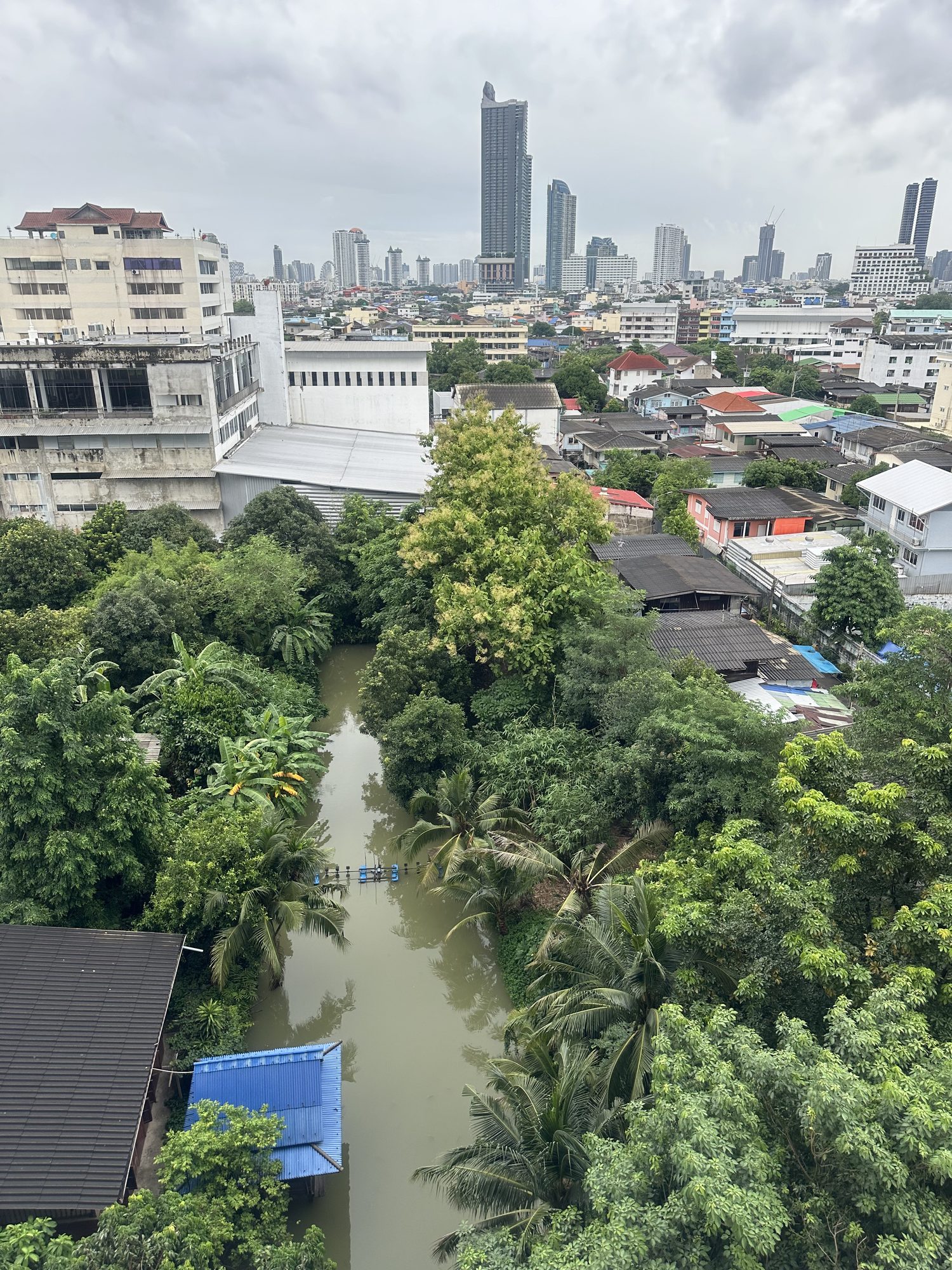
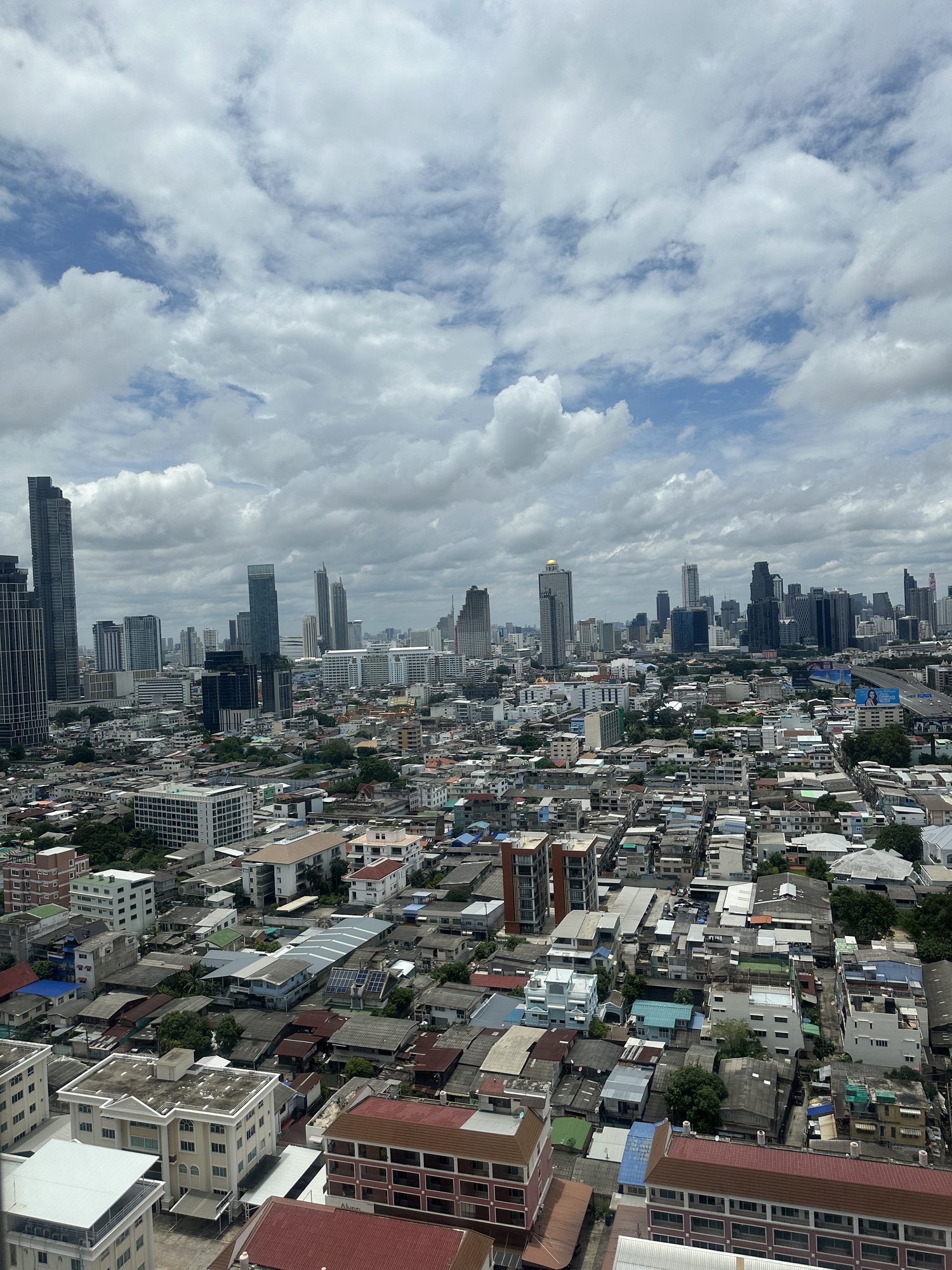
The city the water runs through: a khlong lined with palms and the line of towers on the horizon – Bangkok, summer 2024 (our own photos).
On the prang: what is allowed – and the dress code
The stairs on the central prang are steep, narrow and have a handrail on one side only. Since the restoration you may climb only to the first terrace – one source speaks of the second; the upper levels are closed in any case. It is enough: from there you look across the river to Wat Pho, the golden roofs of the Grand Palace and, downstream, the high-rises, and you stand so close to the porcelain flowers that you can make out the blue painting on individual plates. Flip-flops make the descent unpleasant, a pushchair makes it impossible; keep small children by the hand.
The dress code applies to everyone, even at 35 °C: shoulders and knees covered, no sheer fabrics, no short shorts, shoes off before the ordination hall. If you arrive dressed wrongly, the gate lends you a sarong for about 20 baht plus a 100-baht deposit – it works, but rarely looks good in photos. Better: light long trousers or a long skirt, a T-shirt with sleeves, a scarf for your head against the sun. Behind the prang, towards the river, stands the pavilion with the Buddha footprint; in front of it lies the small garden with the stone Chinese guardian figures that came on the same ships as the porcelain. Which leaves the question of what hour all this looks best.
Best time: 8 a.m. inside, sunset outside
The name promises dawn, but the prang stands on the west bank – in the morning the sun is behind you and the porcelain glows. Between 8:00 and 9:30 it is also still cool enough for the stairs and empty enough for photos without strangers in them; the tour groups come over from the Grand Palace from about 10 a.m., and between 11 a.m. and 3 p.m. heat and crowds peak. The second good window is 16:00–17:30: soft light from the front, the last visitors leaving, the bells audible again.
The famous view, though – the prang as a silhouette against an orange sky – is not from inside the temple but from the east bank: from the riverside walk at Tha Tien pier, from the cafés and the small rooftop terraces between Tha Tien and Wat Pho. The sun sets in Bangkok between roughly 17:50 and 18:40 all year; be there 30 minutes early, the terraces are small and fill up fast. After dark the prang is floodlit, and on the full-moon night of Loy Krathong on 24 November 2026 thousands of krathongs float past it. If you can still choose the season: the dry, cooler months from November to February are ideal; what the rainy season is really like is in Bangkok in the rainy season. Which leaves what the glossy pictures leave out.
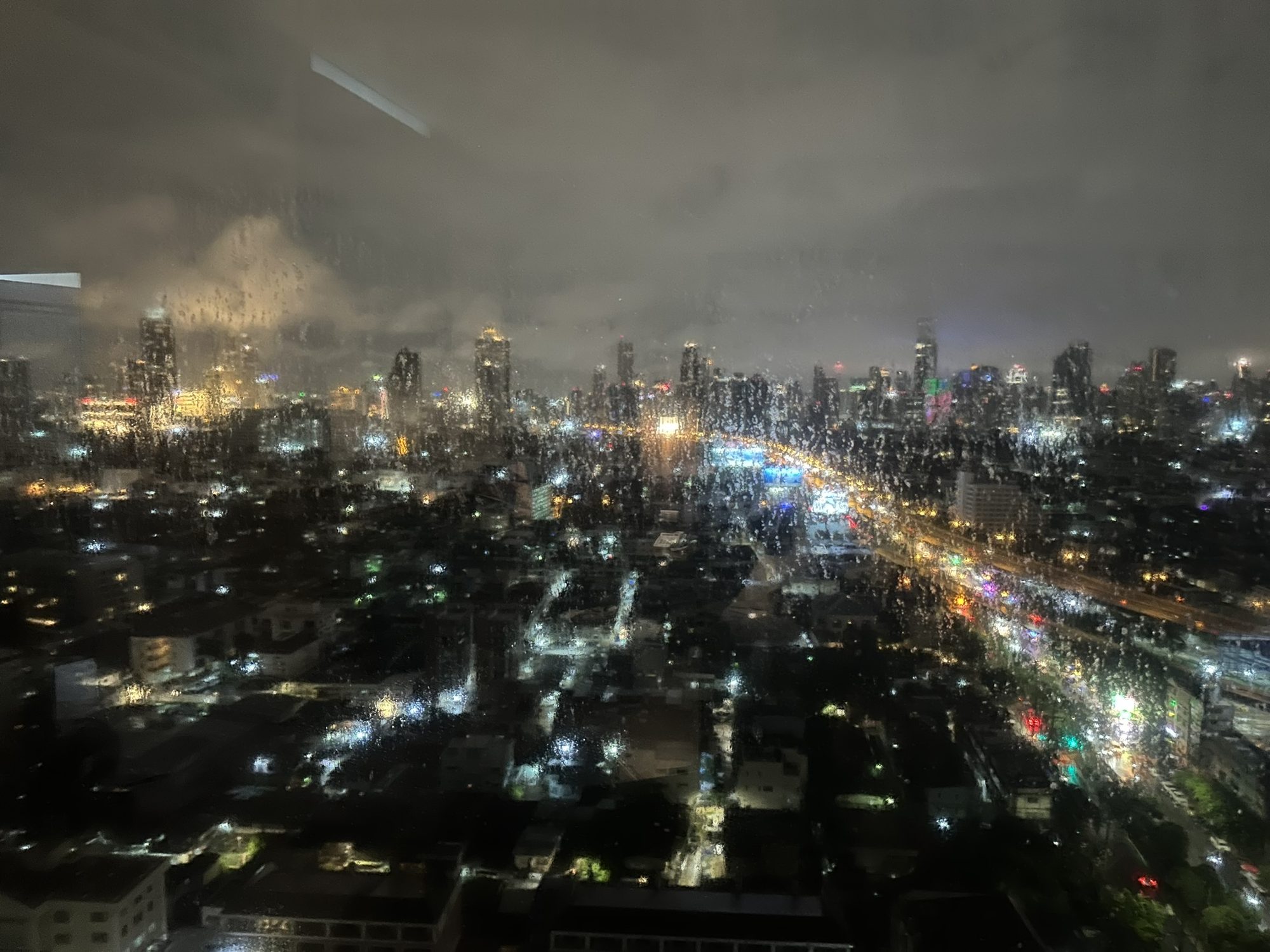
When the prang is floodlit, the rest of the city lights up too: Bangkok at night and a footpath in the evening – summer 2024 (our own photos).
The honest downsides
First: Wat Arun is smaller than it looks in photos. You have seen the grounds in an hour, and anyone planning a whole day will get bored – combine it with the east bank. Second: the costume photography. At peak times dozens of visitors pose around the prang in rented Thai dress with photographers who block entire staircases; before 9 a.m. there is almost none of it. Third: the stairs are steep and the handrail is on one side only – slippery in rain, unpleasant for anyone with a fear of heights. Fourth: Tha Tien pier is tuk-tuk territory. Offers of “temple closed today, I show you another one” or “special price longtail tour” are the oldest trick in town; Wat Arun is open 365 days a year. Fifth: from 11 a.m. to 3 p.m. there is hardly any shade on the grounds, and the porcelain reflects. Know this, and you plan the temple as the first stop of the day – with the rest of the day right across the water.
What to combine Wat Arun with
The classic loop: 8 a.m. Wat Arun, 9:30 back across on the ferry to Wat Pho (the 46-metre reclining Buddha and the massage school – details in Wat Pho Bangkok: entry, massage, best time), 11:30 Grand Palace and Wat Phra Kaew (500 baht, stricter dress code), lunch in the lanes behind Tha Tien, an afternoon break at the hotel, then back to the riverbank for sunset. If you have longer: a lane leads from the temple to the old Portuguese quarter of Kudi Chin with Santa Cruz church, and the khlongs of Thonburi are reached by longtail boat straight from the pier. How the temple fits into three days in Bangkok is in our Bangkok 3-day itinerary; all the city’s big sights, sorted, are in Bangkok things to do. And if you have not decided which month to fly: Best time to visit Thailand by coast has the answer – the answer on entry requirements comes now.
Entry & visa – official websites only
Since 15 September 2026, travellers from most visa-exempt countries – including the EU, the UK, the USA, Canada and Australia – may enter Thailand without a visa for holidays of up to 30 days (the previous 60-day rule has been abolished; check the official list for your nationality). Mandatory are a passport valid for at least six months on arrival and the free digital arrival card TDAC, which you complete online no earlier than 72 hours before arrival. For longer stays there is the e-visa, exclusively from the Thai Ministry of Foreign Affairs. All details, deadlines and pitfalls are in Thailand entry requirements 2026: TDAC, 30 days, official sites.
Thai Immigration Bureau – TDAC (Digital Arrival Card, free): tdac.immigration.go.th
Thai Ministry of Foreign Affairs – e-visa (only if a visa is required or for longer stays): thaievisa.go.th
Austrian Foreign Ministry – travel information Thailand (German): bmeia.gv.at
UK Foreign Office – Thailand entry requirements: gov.uk
Safely to the official site: we deliberately don’t link entry portals here – fake sites look real and charge several times the official fee (it happened to us). The right way, with a QR code straight to the official site, is in our travel guide.
Warning about intermediary sites: The TDAC is free and genuine only at the Immigration Bureau’s address. Searches throw up sites named “Thailand Arrival Card” or “Thai e-Visa Service” first, charging US$30–80 for the same form – we once fell for a site like that ourselves with a motorway vignette. Since then: type the address yourself, never click an ad. You do not need an online ticket for Wat Arun either; “skip-the-line” offers sell you a boat tour at best. In the guide you will find all official links as QR codes – our Bangkok guide is in preparation; until then we keep you posted via the newsletter.
Checklist: Wat Arun in one morning
☐ At Sathorn Pier by 7:30 or at MRT Sanam Chai by 7:45 – at the temple at 8
☐ Small change: 200 baht entry, 10 baht for two ferries, 100 baht deposit for a sarong if needed
☐ Light long trousers or skirt, sleeves, shoes you can slip off quickly
☐ Water, hat, sunscreen – there is hardly any shade on the grounds
☐ Firm soles for the steep stairs, children by the hand
☐ Ignore “temple closed” claims at the pier, decline tuk-tuk tours
☐ Afternoon: Wat Pho and Grand Palace opposite, 17:30 a spot on the east bank for sunset
☐ TDAC completed (72 h before arrival), passport valid 6 months, the 30-day rule in mind
200 baht per person for foreign visitors, roughly US$6 or €5; Thai nationals enter free with ID (as of 11/2026, several 2026 guides). Add 3–5 baht each way for the cross-river ferry from Tha Tien.
How do I get to Wat Arun?
By Chao Phraya Express Boat (orange flag) to Tha Tien pier N8 and then the cross-river ferry, by MRT to Sanam Chai (east bank, then ferry) or to Itsaraphap (west bank, 10–15 minutes on foot), or from Wat Pho in five minutes on foot to the pier.
Can you climb Wat Arun?
Yes, but only to the first terrace of the central prang; the upper levels have been closed since the 2017 restoration. The stairs are steep with a handrail on one side only.
What should I wear to Wat Arun?
Shoulders and knees covered, no sheer clothing, shoes off before the ordination hall. Sarongs are available at the gate for about 20 baht plus a 100-baht deposit (one source quotes 50 baht).
When is the best time to visit Wat Arun?
Between 8:00 and 9:30 for quiet and light on the porcelain, 16:00–17:30 for soft evening light. The sunset with the prang as a silhouette is only visible from the east bank at Tha Tien, not from inside the temple.
How long does a visit to Wat Arun take?
45 to 90 minutes for the prang, terrace, ordination hall and garden. Plan it as the first stop of a day on the river, together with Wat Pho and the Grand Palace on the other side.
Sources: thatbangkoklife.com – How to Visit Wat Arun in 2026 (updated 23 Apr 2026); watarun-guide.com – Entrance Fee 2026 and FAQs (30 Jun 2026); lukfoto.com – Visiting Wat Arun (checked 10/2026); djnajade.com – Wat Arun Bangkok: Tickets, Hours and Tips (26 Oct 2026); tourismattractions.net – Wat Arun Ferry and Tickets Guide (17 Mar 2026); thailandmagazine.com – Chao Phraya River Express (fare table 2025); our own article on the Chao Phraya Express Boat (operator fares, as of 20 Nov 2026); Austrian Foreign Ministry travel information Thailand (accessed 21 Nov 2026). The Bangkok photos are from our own trip in summer 2024; Wat Arun itself is described from research, not from our own visit. All figures as of 11/2026 – entry fee, ferry fares and terrace rules can change without notice.
Plan this tripOur go-to links for a place to stay, rental cars, mobile data and travel gear:
🔔 Get new articles & deals as a notification?No spam – max. 4 a day, switch off anytime.
Your choice
We only use what is necessary to run this website. Everything else – such as statistics or content from third parties – only with your consent. You can change your choice at any time.