Best Time to Visit Thailand: Andaman Sea or Gulf? Month by Month with Official Weather Data
19 Nov 2026 · 14 min read
Quick answer: The best time to visit Thailand for most travellers is December to March – but not everywhere equally. On the Andaman Sea (Phuket, Krabi, Khao Lak), the official 1991–2020 climate normals of the Thai Meteorological Department (TMD) show just 24 mm of rain in February but 350 mm in September. On the Gulf of Thailand it’s the other way round: Ko Samui’s rainy season runs from October to December, with an average of 445 mm in November and only 64 mm in February. Bangkok is driest from November to March, Chiang Mai in December and January – but from February the smoky burning season begins there. Important for many Europeans: since 15 September 2026, Germans and Austrians (and 58 other nationalities) get only 30 days visa-free. Checked 19.11.2026, sources below.
Your first step out of the airport feels like a warm hug. The air smells of jasmine, exhaust and grilled chicken, a tuk-tuk rattles past somewhere. A few days later you’re sitting in a longtail boat, the water beneath you so turquoise it looks fake, limestone cliffs rising straight out of the sea ahead. That’s the picture everyone has of Thailand. Whether you actually experience it – or stare through grey monsoon rain – comes down to one question: when are you going where?
Plan this tripOur go-to links for a place to stay, rental cars, mobile data and travel gear:
We know both sides. Thailand was our first big Asia trip in 2024 – several weeks in summer, from Bangkok via Chiang Mai and Ko Samui to the Andaman Sea. In 2025 we came back and lived on Phuket from mid-October to the end of November. The photos in this post are our own. The numbers, however, aren’t gut feeling: they come from the Thai Meteorological Department’s official climate normals and from Tourism Authority of Thailand announcements, accessed on 19.11.2026.
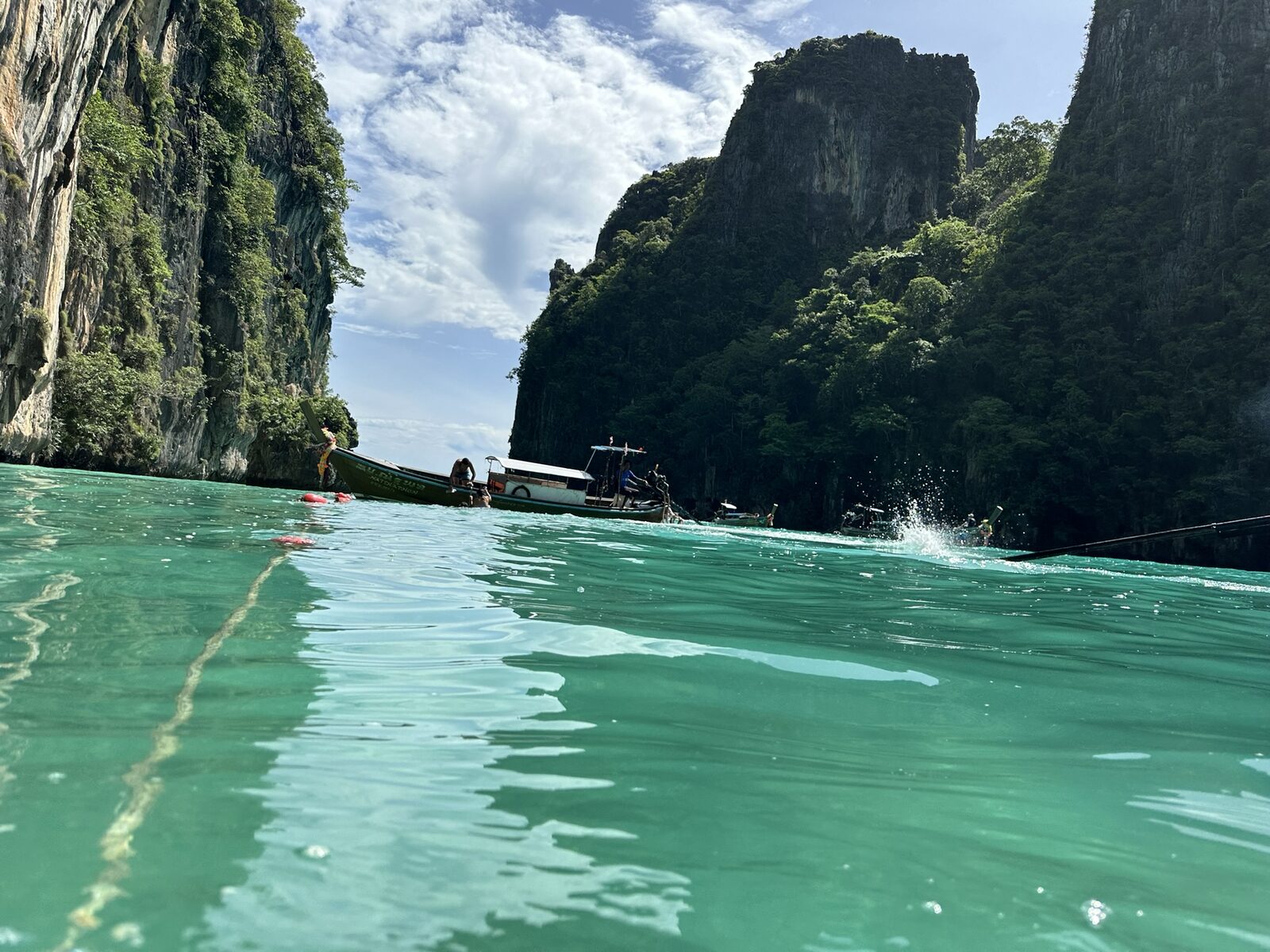
Limestone cliffs and turquoise water on the Andaman Sea – our own photo from August 2024, right in the rainy season.
Best time to visit Thailand: the three seasons
Thailand’s government, drawing on the meteorological department, describes three seasons:
Hot season: mid-February to mid-May. In April, Chiang Mai averages a daily high of 36.7 °C according to TMD, Bangkok 35.7 °C.
Rainy season (southwest monsoon): mid-May to mid-October. It mainly hits the west coast – Phuket, Krabi and Khao Lak – and the north.
Cool season (northeast monsoon): mid-October to mid-February. For most of the country the driest, most pleasant time. But: according to the Thai government, the northeast monsoon brings rain to the east coast of the south – the Gulf with Ko Samui – into December.
“Rainy season” doesn’t mean rain all day, by the way. Typical are heavy showers, often in the afternoon or at night, with sunshine in between. The problem in the Andaman rainy season is less the rain itself than the sea: waves, currents and cancelled boats.
Best time to visit Thailand: Andaman Sea or Gulf?
This is the most important sentence in this post: Thailand has two coasts with opposite rainy seasons. The west coast on the Andaman Sea gets its rain from the southwest monsoon in summer and autumn, the east coast on the Gulf of Thailand from the northeast monsoon in late autumn. According to Thailand’s Land Development Department, rainfall on the west coast of the south peaks in September, on the east coast in November.
Region
Best months
Wettest months
Typical places
Andaman Sea (west coast)
December to March
May to October (peak Sep/Oct)
Phuket, Krabi, Phi Phi, Khao Lak, Ko Lanta
Gulf of Thailand (east coast)
February to August
October to December (peak November)
Ko Samui, Ko Phangan, Ko Tao
Bangkok & central Thailand
November to February
May to October (peak September)
Bangkok, Ayutthaya
North
November to January
May to September; Feb–April smoke
Chiang Mai, Chiang Rai, Pai
Our own assessment based on the TMD climate normals 1991–2020 (see table below).
What does that mean for you? If you want a beach holiday in July or August, Ko Samui is usually a better bet than Phuket. If you want the sea in November or December, head for the Andaman Sea – on Ko Samui that’s the wettest time of year.
Thailand weather month by month: the official numbers
Here are the rainfall and rainy days of the four key weather stations, straight from the Thai Meteorological Department’s 1991–2020 climate normals. TMD counts a rainy day from just 0.1 mm – so a short shower counts too.
Month
Phuket (Andaman)
Ko Samui (Gulf)
Bangkok
Chiang Mai
January
50 mm / 5.6 days
127 mm / 11.1 days
24 mm / 2.6 days
11 mm / 1.3 days
February
24 mm / 3.4 days
64 mm / 5.6 days
21 mm / 2.5 days
10 mm / 0.9 days
March
81 mm / 7.5 days
116 mm / 5.9 days
51 mm / 4.1 days
20 mm / 2.8 days
April
135 mm / 11.7 days
83 mm / 8.1 days
93 mm / 6.5 days
54 mm / 6.8 days
May
237 mm / 18.9 days
132 mm / 14.0 days
217 mm / 15.0 days
168 mm / 14.8 days
June
249 mm / 18.6 days
134 mm / 13.1 days
199 mm / 16.4 days
118 mm / 16.3 days
July
240 mm / 19.1 days
117 mm / 14.3 days
190 mm / 17.2 days
149 mm / 18.8 days
August
309 mm / 19.5 days
102 mm / 14.5 days
227 mm / 19.1 days
223 mm / 20.9 days
September
350 mm / 21.7 days
118 mm / 15.0 days
336 mm / 21.4 days
207 mm / 18.1 days
October
336 mm / 22.7 days
295 mm / 19.3 days
289 mm / 17.0 days
124 mm / 11.8 days
November
178 mm / 15.9 days
445 mm / 18.7 days
45 mm / 5.0 days
41 mm / 4.2 days
December
82 mm / 10.3 days
263 mm / 14.2 days
12 mm / 1.5 days
14 mm / 1.8 days
Source: Thai Meteorological Department, Climatological Data of Thailand 1991–2020 (report 551.586-13-2023), stations Bangkok Metropolis, Phuket, Ko Samui, Chiang Mai. Values rounded.
How to read the table: Phuket is almost dry in February and wettest in September and October. Ko Samui is driest in February and wettest in November – exactly the opposite pattern. Bangkok and Chiang Mai see hardly any rain from December to February.
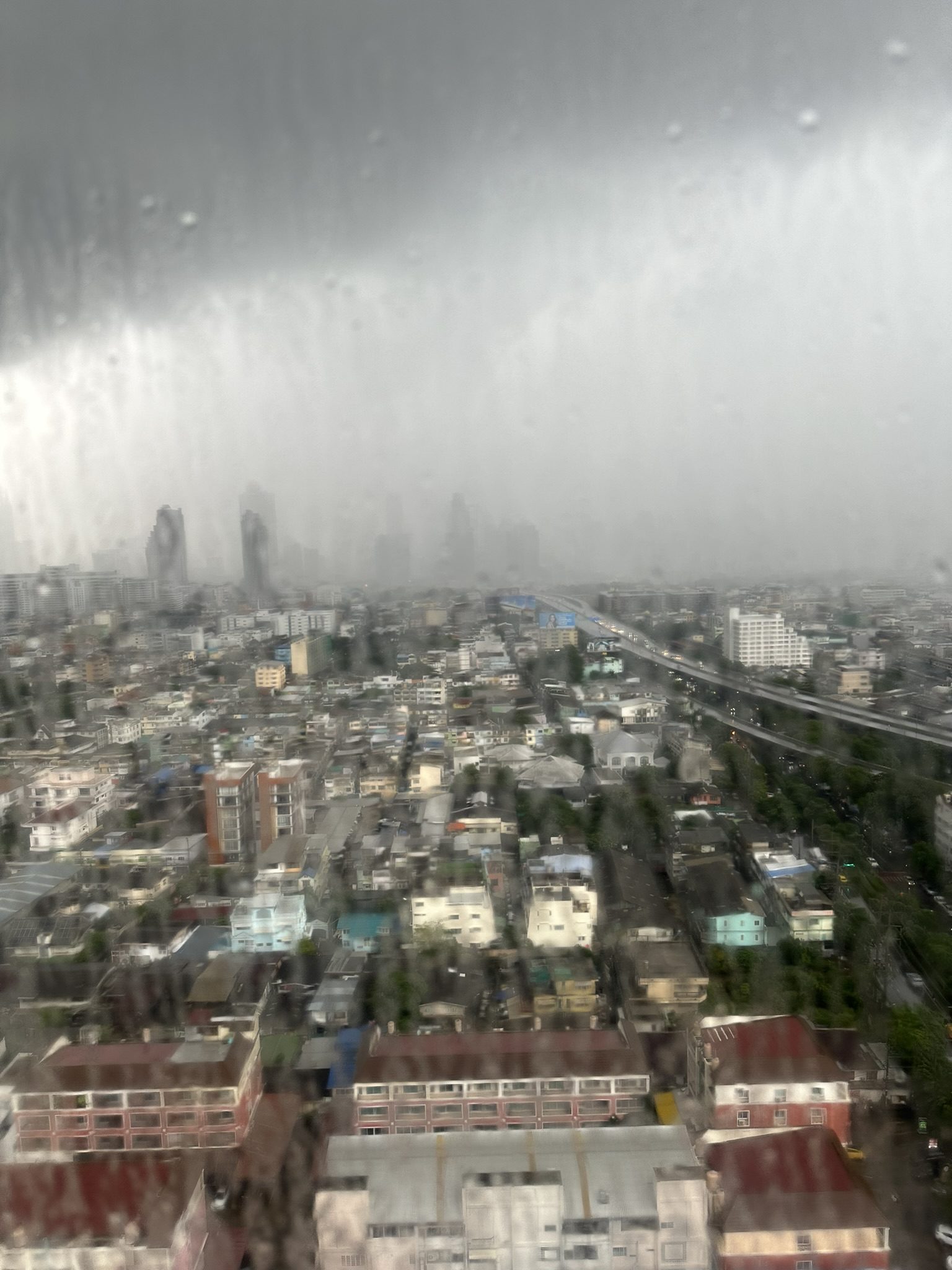
Veils of rain over Bangkok – what a heavy shower looks like from a high-rise window. Our own photo.
Month by month: where to go in Thailand when
January: high season on the Andaman Sea, pleasant in Bangkok and the north. On Ko Samui the rain has usually eased a lot, but isn’t quite over.
February: according to TMD the driest month at almost all four stations. Our favourite for a first Thailand trip. In the north, however, the burning season begins.
March: still good on both coasts, getting hotter. In the north, TMD records haze on almost 27 days on average.
April: the hottest month inland. Mid-April is Songkran, Thai New Year with nationwide water fights – 13 to 15 April in 2027.
May to July: the rainy season starts on the Andaman Sea and prices drop. The Gulf (Ko Samui) is now the better beach choice.
August: summer holidays in Europe – in Thailand, Ko Samui is the best bet. Our Andaman photos are from August 2024 and show sunshine – that can happen in the rainy season too, but it’s no guarantee. Expect cancelled boats.
September and October: the wettest months on the Andaman Sea and in Bangkok. From mid-October, Similan National Park reopens.
November: a transition month. Bangkok and the north dry out, the Andaman Sea improves markedly. Ko Samui now gets the most rain. Loy Krathong falls on 24 November in 2026.
December: high season on the Andaman Sea and in Bangkok – book Christmas and New Year early. According to TMD, Ko Samui is still wet.
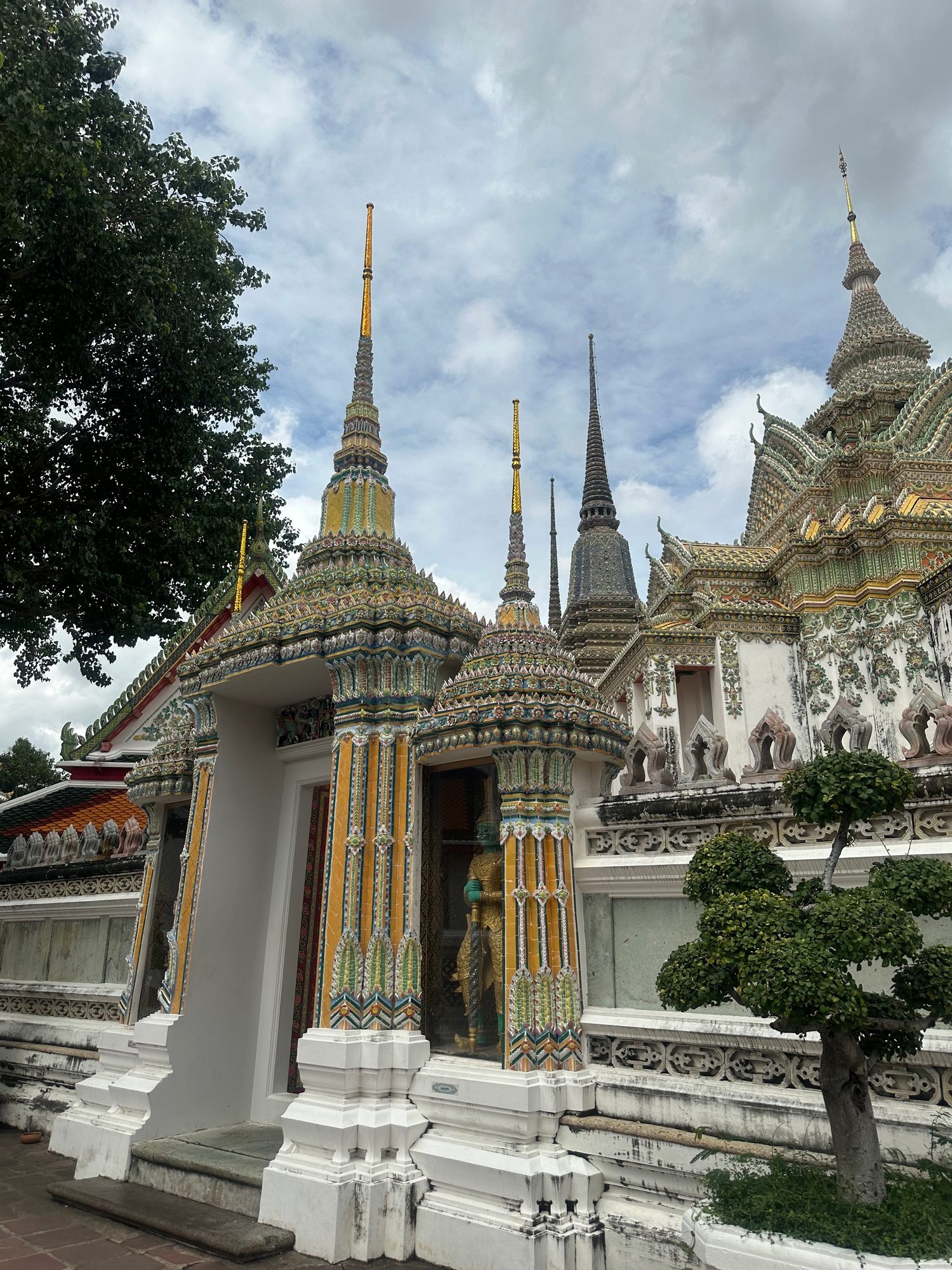
Wat Pho in Bangkok – from November to February you can explore the temples without the monsoon and with a little less heat. Our own photo.
Festivals and events: the best time for the heart
Sometimes the best time to travel isn’t the driest, but when a country shines:
Loy Krathong 2026: full moon on 24 November 2026, with nationwide events from 15 to 29 November according to the Tourism Authority of Thailand (TAT). Everything about Bangkok is in Loy Krathong in Bangkok 2026.
Yi Peng in Chiang Mai: the big CAD KhomLoi lantern festival takes place on 24 and 25 November 2026 at CAD Cultural Center Lanna (Mae On), according to TAT.
Songkran 2027: 13 to 15 April 2027 – three days of water, music and family visits. Accommodation is in demand and transport is packed.
National parks: when the most beautiful islands are closed
A mistake many only notice on arrival: some of the Andaman Sea’s most famous marine parks close every year during the rainy season.
Similan Islands: according to Pattaya Mail, the park was closed from mid-May to mid-October 2026 and reopened on 15 October 2026 for the season until 15 May 2027. According to The Nation, the same closure applied to the Surin Islands.
Maya Bay (Phi Phi): closed from 1 August to 30 September 2026, open again since 1 October (Pattaya Mail).
So plan your boat trips between mid-October and mid-May. Tours with clear inclusions and free cancellation are on GetYourGuide (advertising). Read about our own boat trip in Phi Phi and Krabi by longtail.
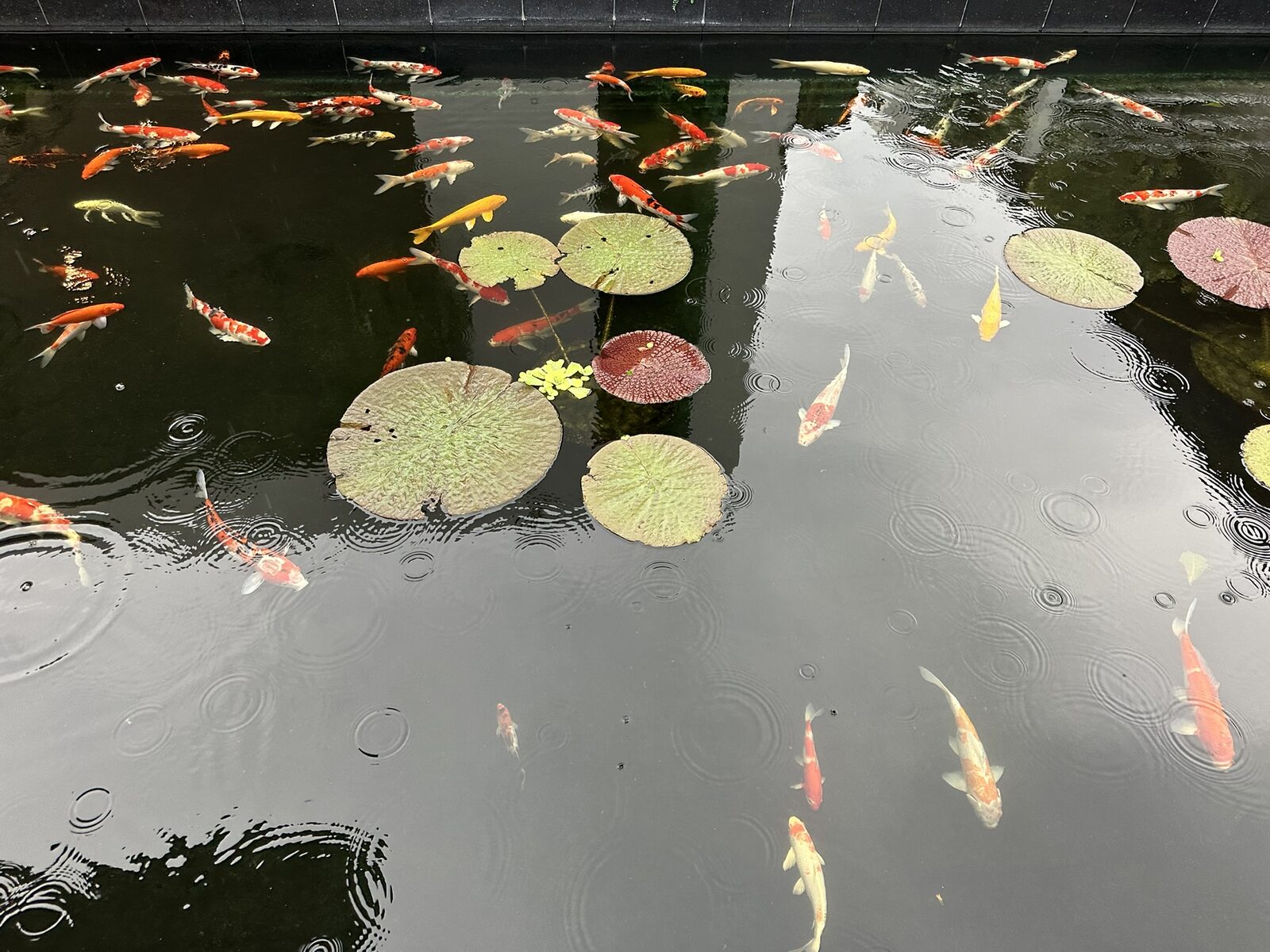
Raindrops on a koi pond – our own photo from October 2025, when we lived on Phuket. According to TMD, October is still among the wettest months on the Andaman Sea.
Best time to visit Thailand’s north: beware the burning season
The north is a dream from November to January: dry, pleasantly cool at night, markets in full swing. From February that changes. According to TMD climate normals, Chiang Mai averages haze on 22 days in February and almost 27 days in March. Air-quality company IQAir writes that the burning season typically runs from January to April, peaking in March; on 4 March 2026 Chiang Mai was in the “unhealthy” range. If you have respiratory issues or are travelling with children, visit the north between November and January.
Entry: what changed in 2026
Visa-free now only 30 days: according to TAT, since 15 September 2026 Germany and Austria are on the list of 60 countries with 30 days visa-free entry instead of 60. If you want to stay longer, plan ahead – and check the rules for your own passport. More in our post Thailand entry requirements.
Digital arrival card TDAC: the Thailand Digital Arrival Card has been mandatory since 1 May 2025. It is free of charge and is completed within the three days before arrival.
Watch out for scams: many intermediary sites look like the authority and charge for a form that is free. According to Malay Mail (01.05.2025), one fake site charged US$10 per person; according to Khaosod English (29.03.2026), around 10% of foreign arrivals used such fake sites. How to spot the real one: the Thai immigration site ends in .go.th. This exact thing happened to us with an entry form – we paid an intermediary many times the real cost. That’s why our Thailand guide shows the right way: you’ll find the direct route to the correct site – with a QR code and step by step – in our guide.
Entry fee: a 450-baht tourist fee is planned but, according to The Nation (15.08.2026), was not yet in force; collection from air arrivals is expected in the first quarter of 2027 at the earliest.
Our recommendations for Thailand (advertising – we earn a small commission at no extra cost to you):
Boat trips, temples, cooking classes: Thailand on GetYourGuide – mostly free cancellation, important in the rainy season
Compare hotels in Phuket, Krabi, Ko Samui and Bangkok: Booking.com · Villas and apartments: Airbnb
☐ Visa-free stay planned for max. 30 days (check your passport’s rules)
☐ TDAC free, within 3 days before arrival, only on the site ending in .go.th
☐ Passport valid for at least 6 months
☐ Tours with free cancellation, especially in the rainy season
☐ Travel medical insurance sorted
☐ Light rain jacket, sun protection, waterproof pouch for your phone
FAQ: best time to visit Thailand
When is the best time to visit Thailand?
For a round trip with Bangkok, the north and the Andaman Sea: December to February. According to TMD, February is the driest month at almost all major stations.
When is the rainy season in Thailand?
The southwest monsoon brings rain from mid-May to mid-October, mainly on the Andaman Sea and in the north. On the Gulf (Ko Samui), most rain falls from October to December.
Phuket or Ko Samui – which is better in summer?
In July and August usually Ko Samui. According to TMD it gets about 102 mm of rain in August, Phuket about 309 mm.
Can you go to Phuket in November?
Yes, but November is a transition month: according to TMD, Phuket averages 178 mm on almost 16 rainy days, December only 82 mm. We lived on Phuket from mid-October to the end of November 2025.
When should you avoid Ko Samui?
October, November and December – in November it averages about 445 mm of rain according to TMD, more than any other month.
When is the best time to visit Chiang Mai?
November to January. From February the burning season brings lots of haze, peaking in March according to IQAir.
How long can I stay in Thailand without a visa?
Since 15.09.2026, 30 days for Germans and Austrians (TAT); check your own nationality. The TDAC is mandatory and free.
When is Songkran 2027?
13 to 15 April 2027 – Thai New Year, with water fights across the country.
When are the Similan Islands open?
For the 2026/27 season from 15 October 2026 to 15 May 2027; then the park closes for the rainy season.
Bottom line: there’s always a right coast
The beauty of Thailand: somewhere it’s always in season. Escaping winter, you’ll find turquoise water and sunsets that catch in your throat on the Andaman Sea. With summer holidays, head to the Gulf. And to experience Bangkok and the north, come between November and February. Check the table, pick the right coast, fill in the TDAC only on the real site – and then let this country embrace you. We’ve come twice and would fly back any time.
Thai Meteorological Department (TMD): Climatological Data of Thailand for 30 Year Period 1991–2020, report 551.586-13-2023 (tmd.go.th, accessed 19.11.2026)
Government Public Relations Department, thailand.go.th: “The Seasons of Thailand” and “Monsoon winds and the climate of Thailand” (2023, based on the meteorological department)
Land Development Department Thailand: rainfall by region (ldd.go.th)
Tourism Authority of Thailand (TAT Newsroom): Loy Krathong 2026 (05.11.2026); new 30-day visa exemption from 15.09.2026 (01.09.2026)
🔔 Get new articles & deals as a notification?No spam – max. 4 a day, switch off anytime.
Your choice
We only use what is necessary to run this website. Everything else – such as statistics or content from third parties – only with your consent. You can change your choice at any time.