Himara Albania 2026: Livadhi, Gjipe, Jale, Porto Palermo – Beaches, Prices and Why It Is the Best Base on the Riviera
22 Nov 2026 · 16 min read
In short: Himara (Himarë) is the best base on the Albanian Riviera if you want more than a sunbed in Ksamil. From town you reach, in 10 to 25 minutes, Livadhi (1.5 km long, free parking), Potami and Llamani (sunbed sets 10–20 €), Jale (parking 200–300 lek) and Gjipe (car park 300–500 lek, then a 2.5 km walk), plus Porto Palermo castle (300 lek, cash only) above a Cold War submarine tunnel. From Tirana the bus takes 3 to 3.75 hours (about 16 €), from Saranda 1.5 hours (about 10 €). Best months: June and September. Prices as of 10/2026 from local and operator sites, sources below.
It is 7:10 am and the sun has not yet cleared the mountains. The Ceraunian range stands behind Himara like a two-thousand-metre wall, and as long as it holds back the light, Spile beach lies in shadow – flat, silent, turquoise. A fisherman drags his boat up the pebbles, the first coffee drifts out of a bar, and at the end of the promenade the old town of Kastro looks down on all of it from its hill, as it has for two thousand years. At nine it gets loud; by eleven the sunbeds are taken. Right now you hear only the stones in the water. This is the moment you understand why people stay here for two weeks instead of two nights.
Plan this tripOur go-to links for a place to stay, rental cars, mobile data and travel gear:
In this article: which beaches around Himara have which character and what they cost in 2026, how to get to Gjipe without ruining the day, what Porto Palermo castle has to do with Ali Pasha and with Soviet submarines, how to get here from Tirana, Saranda or Vlora, when to come, the honest downsides, entry via official sites only, a checklist and FAQ. One honest note first: we have not been to Himara itself yet; we know this coast from Saranda and Ksamil in July 2025, and the figures here come from local portals and operator pages dated 2026.
Why Himara and not Ksamil or Dhërmi
The Albanian Riviera is a strip roughly 20 kilometres long and 5 kilometres wide, squeezed between the Ionian Sea and the Ceraunian Mountains. Himara sits right in the middle. Ksamil to the south is the postcard with the little islands, but in August it is sunbed against sunbed; Dhërmi to the north has the most expensive beach clubs on the coast (sunbed sets 15–30 €). Himara, by contrast, is a small town – about 3,900 people in the administrative unit at the 2023 census – with a bus station, ATMs, a supermarket, a promenade and an old town people still live in. From here, eight beaches of completely different character are at most 25 minutes away, from the town beach with sunbeds to a canyon with no electricity.
The town also has a trait you hear straight away: in Himara, Dhërmi and Palasa, Greek is traditionally spoken alongside Albanian; menus are often bilingual, and there has been a Greek school since 2009. Up in Kastro – stone houses, car-free lanes, a ruined castle whose oldest walls date from the 4th to 3rd century BC – it feels more like an Ionian island than a Balkan state. That mix is what makes the place. And it starts at the water.
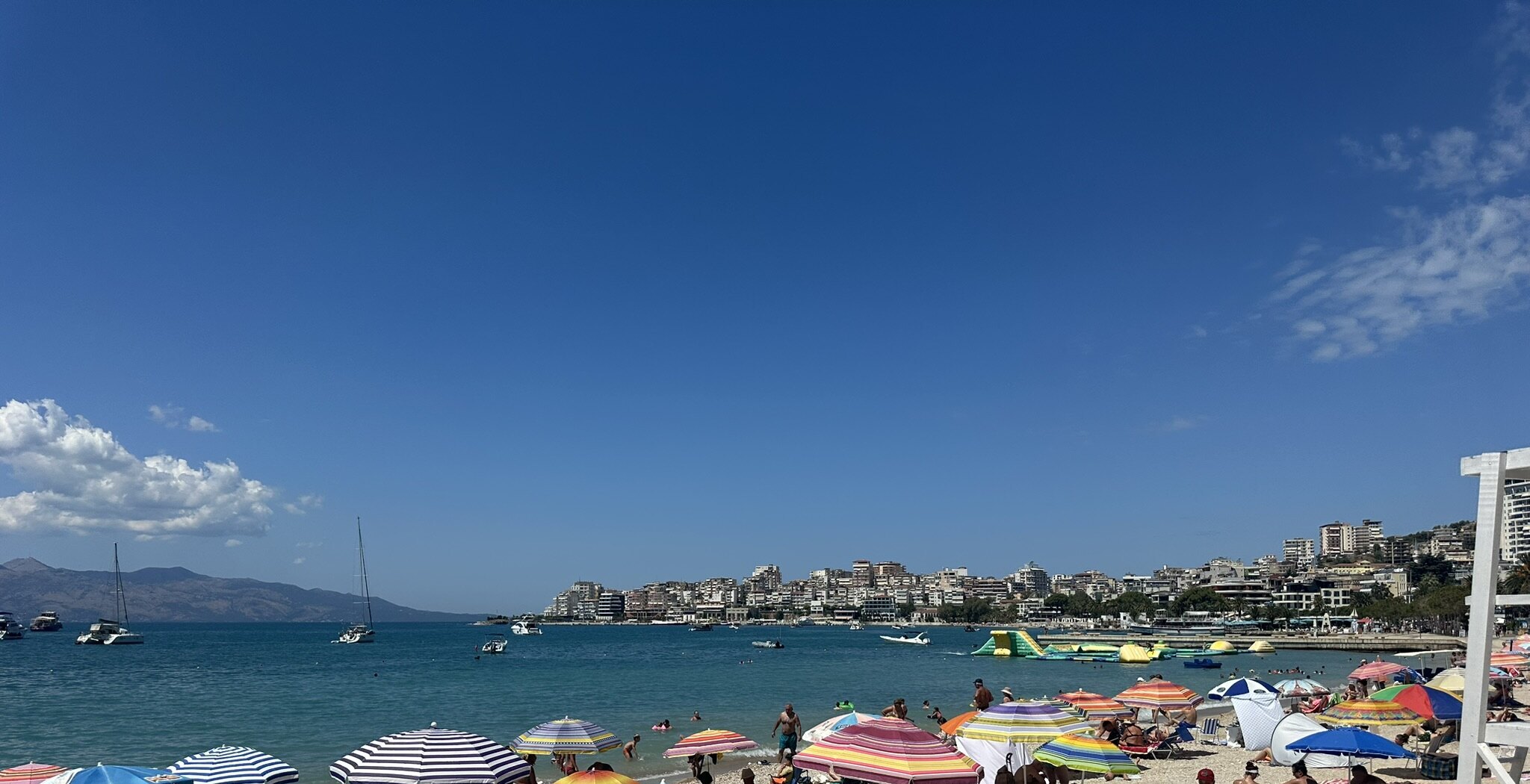
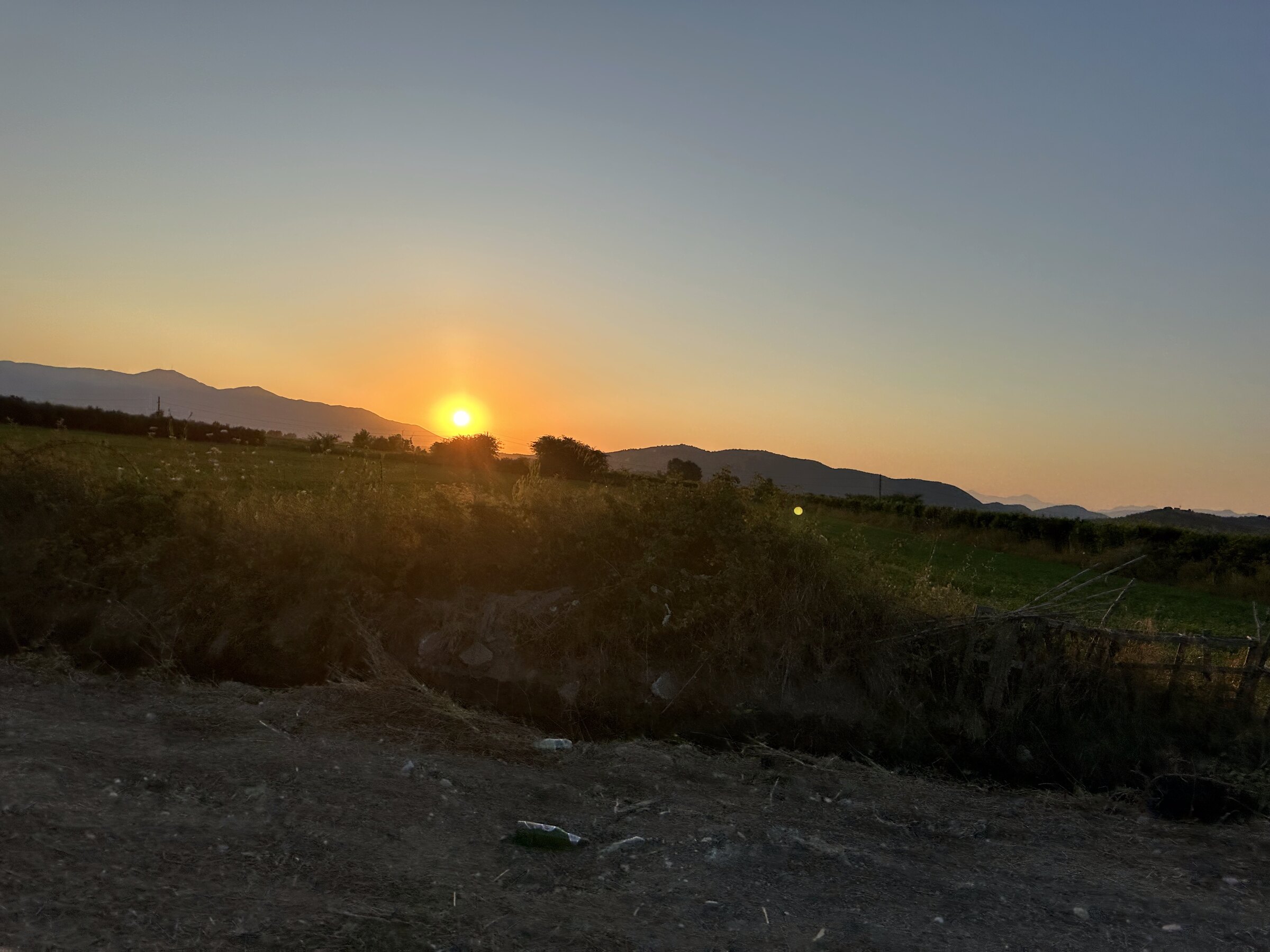
The same coast, 50 kilometres further south: Saranda’s town beach and evening over the fields near Xarrë – from Saranda it is a 1.5-hour bus ride to Himara. Southern Albania, July 2025 (our own photos; we have not photographed Himara itself).
Himara’s beaches: eight bays, eight characters
All beaches in Albania are public by law; you never pay admission, only for a sunbed and umbrella if you want them. The prices below are, according to the local portal himara.net (as of 10/2026), for a set of two loungers and one umbrella per day; in August they run about double the June rate, in September 20 to 40 percent below it. Payment is cash in lek – reckon roughly 100 lek to the euro and check the rate before you travel.
Beach
Distance from Himara
Sunbed set 2026
Character
Spile (town beach)
on foot
500–1,000 lek (5–10 €)
400 m of fine pebbles, promenade, bars, kayak hire; Sfageio just past the pier is shallower and free. For the evening and for day one.
Livadhi
10 min by car, north
1,000–2,000 lek (10–20 €)
1.5 km long, the biggest beach in the area, free parking right on the beach, restaurants on the sand. Room even in August.
Potami
8 min by car, south
10–20 €
Smaller, calmer, tidy rows of loungers. For days when you don’t want to search.
Llamani
4–5 km south, short gravel track
10–20 € or free at the edges
Large stones underwater – water shoes are not a tip here but a must. Clear water for snorkelling in return.
Filikuri
20–30 min on foot or 30 min by kayak from Spile
free, no facilities
Boat, kayak or trail only. Bringing nothing means being able to buy nothing.
Jale
12–13 km north, 20 min by car
800–2,000 lek (8–20 €), parking 200–300 lek
300–400 m of pebbles and sand, beach bars, camping, dive centre (from 110 €). Steep access road with hairpins, full by 11 am in summer.
Gjipe
15 km north, 25–30 min by car + 2.5 km on foot
free; car park 300–500 lek/day
Canyon, caves, pebble bay, eco camping. The beach you need water and shoes for – see below.
Porto Palermo
8–10 km south, 15–20 min
swimming free; castle 300 lek
Small pebble strip under the castle, no café, no shop. The excursion, not the beach day.
If you only have three days: one day at Livadhi or Potami to arrive, one day at Gjipe, half a day at Porto Palermo with the evening at Spile. If you have two weeks, Himara is the place where you take a different bay every day and still have Filikuri left at the end. The one beach everyone talks about, though, needs some preparation.
Gjipe: the canyon, the car park and the 2.5 kilometres
Gjipe is a pebble bay at the mouth of a canyon, 15 kilometres north of Himara and 7 kilometres south of Dhërmi. There is no road to the water. From the SH8 coast road, an unpaved track of about 2 kilometres branches off (5–8 minutes, passable in a standard car when dry) and ends at a car park for 50 to 70 cars. Attendants collect there between roughly 8 am and 6 pm: 300 lek in June, 500 lek in July and August, 1,000 lek overnight, cash only, no receipts; outside the season the lot is often unattended and free. In summer it is full between 10 and 11 am, and there is no overflow.
From the car park a rocky path with no shade drops about 2.5 kilometres and roughly 200 metres in height: 20 to 45 minutes down, 30 to 55 minutes back up, depending on source and pace. Carry 1.5 to 2 litres of water per person and wear proper shoes – no flip-flops. If you don’t want to walk, summer offers two alternatives: a jeep shuttle from the car park (500–1,000 lek per person) or a boat from Himara (about 20 minutes; water taxi 15–30 €, half-day group tour 25–40 €). At the bottom there is eco camping (tent 30–40 € per night, pitch 10–15 €), a beach bar in July and August, and otherwise only what you carry. Two warnings from the local portal: in rain the canyon can turn into a torrent, and the path is not for children under five or six. The short inland canyon loop (500 metres, 15–20 minutes) is easy; the full gorge route (1.5 kilometres, 1.5–2 hours) involves scrambling.
One number you should not copy: the GPS coordinates for the car park differ by about 6 kilometres between two articles on the same site. Follow the “Gjipe” sign on the SH8 and, if in doubt, ask in Vuno – the village sits right at the turn-off. And when you are back up in the evening, the best reward is not a shower but a view from a castle wall.
Porto Palermo: Ali Pasha’s castle above the submarine tunnel
Eight to ten kilometres south of Himara a small peninsula sits in an almost enclosed bay, and on it stands a triangular fortress of dark stone. Legend says Ali Pasha of Tepelena built it in 1804 – the Ottoman governor who took Himara in 1798 and was killed in 1822; some historians think the structure is older and Venetian. Entry is 300 lek, cash in lek only, no euros – the nearest ATMs are in Himara. Open, according to the local portal, usually 9 am to 7 pm in summer and irregularly off season. Parking at the gate is free, a taxi from Himara costs 1,500 to 2,000 lek one way, and there is no bus. Allow 45 minutes to 1.5 hours and bring water; there is neither café nor shop.
The real thing you see from the road on the north shore: a tunnel in the rock, over 650 metres long and about 12 metres high, built in 1969 under Enver Hoxha and designed for four Soviet Whiskey-class submarines. The bunker lies in a military zone, was briefly open to visitors in August 2024 and has been closed since – check on site. Swimming in the bay costs nothing; kayak, SUP and snorkel tours are offered for around 41 € per person. The view from the castle wall across the bay to the south is the reason you drive here. That leaves the question of how you get to Himara at all.
Getting there: bus from Tirana, Saranda or Vlora – and the Llogara road
Since 5 July 2024 arriving from the north has been a different story: the Llogara Tunnel, 5.9 kilometres long and the longest in Albania, passes under the 1,000-metre pass and, according to the operator, cuts the Dukat–Palasë stretch from 30 to 7 minutes. The pass road still exists; it is the prettier option, with a view over the whole Riviera, but winding and with few petrol stations – fill up in Vlora or Orikum.
Connection
Duration
Price
Note (as of 10/2026)
Tirana → Himara, bus
3–3.75 h
about 16 € / 1,200–1,500 lek cash
216 km. Timetabled departures 7:00, 9:00, 10:30, 13:00, 15:30, 18:00 from the South/North terminal near Casa Italia (taxi from the centre 1,000–1,800 lek). Back from Himara from 5:15 am; Olgeno leaves from the bus station, Riviera Tours from the MALPOS petrol station.
Tirana → Himara, car
3.5–4 h
hire car from about 25 €/day
Route Fier–Vlora–Llogara. Taxi transfer 130–190 € (sedan), 170–220 € (minivan).
Saranda → Himara
1.5 h bus / 1–1.5 h car
about 10 €
53 km. Transbus 5:30, 7:00, 9:00, 10:00; Olgeno 13:30, 18:00. Stops on request at the beach turn-offs.
Vlora → Himara
2.5 h bus / 1.5–2 h car
about 8 €
73 km. Bregasi 10:00 and 12:30. By car via tunnel or pass.
Corfu → Saranda, ferry
30–90 min
per operator
Then bus or hire car onwards. Flying to Corfu is usually the fastest option from Central Europe.
Compare flights to Corfu or Tirana on Kiwi.com (ad). No bus runs down to the water at Jale or Gjipe: the Himara–Vlora line will drop you at the turn-off past Vuno on request, after which it is a steep 20 to 30 minutes on foot. Without a car you are left with Spile, Livadhi, Potami and the boats – which is perfectly enough for a week. How the coast fits together and which town suits which kind of traveller is in our comparison Albanian Riviera: Ksamil, Saranda, Himara and Dhërmi; the full loop through the country is in the Albania road trip in 10 days. The coastal stretch itself, with all prices and the official entry links as QR codes, is collected in our guide “Roadtrip Balkan & Griechenland” (in German). That leaves the question of when.
Best time to visit: June and September – and why not August
The water off Gjipe is, according to the local portal, 22 °C in June, 24 in July, 25 in August and 23 in September; in April it is 16, in May and October 18 to 22 °C. June and September are the best months in every source: warm enough to swim, sunbeds 20 to 40 percent cheaper than in August, car parks free, buses not crowded. August is the high season for Albanians themselves and for Italians off the ferry – then the weekends at Jale and Gjipe are the opposite of what you are looking for here. October is quiet, but campsites and many beach bars close, and the castle keeps irregular hours.
Two dates for the calendar: the Jal Jam festival on Jale beach (free, 11–12 September 2026) and the Kala Festival in Dhërmi/Drymades (3–10 June 2026) fill their bays completely for a few days – great if you want to go, bad if you want peace. And one thing no brochure tells you: the mountains behind Himara hold back the morning sun until around nine. The beach is cool and empty early – and that is exactly when it is at its best.
The honest downsides
Himara is not a finished destination, and that is part of the appeal – but not for everyone. Almost everything runs on cash in lek: parking attendants, sunbeds, the castle, often restaurants too. Without a car, Jale and Gjipe are a chore. The access roads to Jale (hairpins) and Gjipe (gravel) demand concentration, and the SH8 to Vlora over the pass is no place for tired drivers in fog or with coaches coming the other way. Prices vary between sources and seasons; what we give as a range can be higher at a single bar in August. English is spoken in bars and guesthouses, not always at the bus station. And the sea has stones: water shoes belong in the luggage, not in the deliberation.
What there isn’t: beach admission, reservation systems, compulsory sunbeds. You can walk to the edge of any bay with your towel every day and pay nothing. That has become rare in Europe. If this grabs you, read next how to do the Blue Eye and the old town of Gjirokastër from this coast in one day – and sign up for our newsletter if you don’t want to miss the Corfu–Saranda ferry article for 2027.
Entry & visa – official sites only
Albania is neither an EU nor a Schengen member. Citizens of the EU, the UK, the US, Canada and Australia enter visa-free for stays of up to 90 days; a passport is required for most, while EU citizens may also use a national ID card, which must still be valid on departure – Austria’s foreign ministry recommends three months’ remaining validity. With your own car you need the Green Card with “AL” listed. When returning to the EU (Greece, Montenegro–Croatia), non-EU citizens are subject to EES and – once operational – ETIAS; EU citizens are not affected.
Austrian Federal Ministry for European and International Affairs, travel information Albania (German): bmeia.gv.at
Albanian Ministry for Europe and Foreign Affairs (visas, entry): punetejashtme.gov.al
Albanian State Police (border crossings, waiting times): asp.gov.al
EU – EES and ETIAS for non-EU citizens: travel-europe.europa.eu
Safely to the official site: we deliberately don’t link entry portals here – fake sites look real and charge several times the official fee (it happened to us). The right way, with a QR code straight to the official site, is in our travel guide.
Warning about intermediary sites: Albania has no e-visa and no online registration for EU, UK or US citizens – anyone selling you one is charging for nothing. The beaches around Himara need neither tickets nor reservations; sites offering “Gjipe Beach tickets” or “Porto Palermo skip-the-line” are at best selling you a boat tour at a mark-up. For Corfu–Saranda ferry tickets and for the neighbouring countries’ motorway vignettes, resellers charging several times the price come up first in search results; we fell for one of those vignette sites ourselves. Since then: official and operator sites only, type the address yourself, never click through an ad. In the guide you will find all official links as QR codes.
Checklist: Himara as your base
☐ Lek in cash from Himara: ATMs in town, none at the beaches or the castle
☐ Water shoes (Llamani, Jale, Gjipe), 1.5–2 litres of water per person for Gjipe
☐ Gjipe car park before 10 am, 300–500 lek in exact change; stay out of the canyon in rain
☐ Porto Palermo: 300 lek per person cash, bring water, check opening hours on site
☐ Jale/Gjipe without a car: bus to the turn-off past Vuno, allow a 20–30 minute walk
☐ Fuel up in Vlora or Orikum if you take the Llogara pass instead of the tunnel
☐ Book June or September; know the festival dates at Jale (11–12 Sept) and Dhërmi (3–10 June)
☐ Passport/ID with 3 months’ validity, Green Card with “AL” in the car
For photos and adventure Gjipe (canyon, 2.5 km walk, free), for relaxed days Livadhi (1.5 km long, free parking, sunbeds 10–20 €), for the evening the town beach Spile with its promenade. Llamani and Filikuri are the bays for snorkelling – with water shoes.
How much is a sunbed on the Albanian Riviera?
Two loungers plus umbrella around Himara usually cost 10 to 20 € per day (1,000–2,000 lek), at the town beach Spile 5 to 10 €, in Dhërmi up to 30 €. August is about double June; all beaches are public and a towel at the edge costs nothing (as of 10/2026, himara.net).
How do I get to Gjipe Beach?
By car 15 km north of Himara to the car park at the end of the gravel track (300–500 lek), then 2.5 km downhill on foot (20–45 minutes). Summer alternatives: jeep shuttle from the car park (500–1,000 lek) or a boat from Himara (about 20 minutes, water taxi 15–30 €).
How long is the bus from Tirana to Himara?
3 to 3.75 hours for 216 km, fare about 16 € or 1,200–1,500 lek cash to the driver, six departures a day between 7:00 and 18:00 from the terminals near Casa Italia (as of 10/2026). From Saranda it is 1.5 hours for around 10 €.
How much is Porto Palermo castle?
300 lek entry per person, cash in lek only, free parking at the gate. Usually open 9 am to 7 pm in summer; the submarine tunnel next door is a restricted zone and can only be seen from the north-shore road.
When is the best time to visit Himara?
June and September: water 22 to 23 °C, sunbeds and rooms 20 to 40 percent cheaper than in August, free parking. July and August are full and expensive; in October campsites and beach bars close.
Sources: himara.net – Best Beaches in Himara (updated 11 Jul 2026), Jale Beach Guide (10 Oct 2026), Gjipe Beach Guide (2 Apr 2026) and Gjipe Parking Guide (2 May 2026), Porto Palermo Castle Guide (10 Oct 2026), Bus Tirana–Himara (10 Oct 2026), Free vs. Paid Beaches (17 Mar 2026) – a local portal that also sells bookings; prices are its own figures. Wikipedia DE/EN – Himara (population 2023 census, Kastro, Greek minority, Ali Pasha 1798/1804/1822, Porto Palermo bunker), Llogara Tunnel (5.9 km, opened 5 Jul 2024, Dukat–Palasë 30 → 7 minutes); bmeia.gv.at – travel information Albania. Where sources disagree (Gjipe parking 300–500 lek, water taxi 15–30 €, Jale 12 or 13 km) we give the range. Our own photos are from Saranda and Xarrë (July 2025), not from Himara. All figures as of 10/2026 – prices and timetables change without notice.
Plan this tripOur go-to links for a place to stay, rental cars, mobile data and travel gear:
🔔 Get new articles & deals as a notification?No spam – max. 4 a day, switch off anytime.
Your choice
We only use what is necessary to run this website. Everything else – such as statistics or content from third parties – only with your consent. You can change your choice at any time.