Zakynthos beaches: the best coves – and why Navagio is closed in 2026
9 Nov 2026 · 16 min read
Short answer: The best Zakynthos beaches are not in Laganas: Gerakas (turtle nesting beach in the marine park, open only from 7 am to sunset), Porto Limnionas (turquoise rock fjord on the west coast, no sand), Xigia (sulphur springs in the sea), Banana Beach (long, sandy, families) and Dafni (quiet, national park). The famous Navagio Bay is closed until at least 31 October 2026: no landing, no swimming, boats must keep 50 metres away – you can still see the shipwreck from a boat or from the cliff (source: Joint Ministerial Decision, published 06/2026). We spent four days on the island by car in July 2025.
9:20 am, Porto Vromi. The outboard splutters, the skipper pulls in the line, and for twenty minutes there is nothing but limestone wall, water and the shadow of your own hand. Then the rock opens up and the blue turns so bright you squint. Down on the pebbles lies a rusty freighter as if someone had forgotten it there. Nobody did. The Panagiotis ran aground in a storm on 5 October 1980 – with contraband cigarettes on board, as court documents released later suggest. Since then the cove has been the photo everybody knows of Zakynthos. And since 2022 it has been a place nobody is allowed to set foot on.
Plan this tripOur go-to links for a place to stay, rental cars, mobile data and travel gear:
In this article: the beaches on Zakynthos that are really worth it – region by region, with access, facilities and honest downsides –, the current status of the Navagio closure and how to see the wreck anyway, the rules in the marine park, getting there by ferry or plane, costs, traps, a checklist and the most common questions. Everything else the island has to offer is in Zakynthos: the sights that are really worth it.
Zakynthos beaches at a glance: which one suits you?
Beach
Region
Access
Ground & facilities
Best for
Navagio (Shipwreck Beach)
north-west
boat only – landing banned in 2026, boats ≥ 50 m
pebbles, no facilities
photos from the boat and the platform
Gerakas
south, Vasilikos peninsula (marine park)
car park above, 5-min walk; 7 am to sunset
fine sand, shallow, a few approved sunbeds, no private umbrellas
families, turtle-friendly, quiet
Porto Limnionas
west coast near Agios Leon
winding road, steps and ladders into the rocks
no sand, rock platforms, taverna, no shade
snorkelling, confident swimmers
Porto Roxa
west coast
road, concrete terraces with ladders
rocks, sunbeds on terraces, tavernas
sunset, swimming in deep water
Xigia
north-east
road, steep path down
pebbles, milky water smelling of sulphur
curiosity, “natural spa”
Makris Gialos
north-east
road
pebbles beneath cliffs, small cove
clear water, snorkelling
Banana Beach
east, Vasilikos
road, car parks
long sandy beach, sunbeds, bars, water sports
families, groups
Dafni
south (marine park)
unpaved road
sand, a couple of tavernas, nesting rules
quiet, park visitor centre nearby
Kalamaki
Laganas Bay (marine park)
village right on the beach
sand, shallow for a long way, sunbeds only in zones, cleared at night
families with small children
Marathonisi
island in Laganas Bay
boat only from Laganas/Kalamaki/Keri
sand and pebbles, parts closed (nesting)
boat day with swim stops
Sources: Joint Ministerial Decision on Navagio (Government Gazette, 06/2026), marine park rules according to signage and park information (as of 11/2026), our own trip 14–17 July 2025. Sunbed prices vary by season; we paid for sunbeds everywhere in July 2025.
Ten beaches, ten characters – and the most famous one is the one you may not set foot on in 2026. So first, the truth about Navagio.
Navagio Bay 2026: closed – and still the island’s wow spot
The facts: in June 2026 Greece extended the closure of Navagio Bay by Joint Ministerial Decision until 31 October 2026. That means: entering the beach is prohibited, swimming anywhere in the cove is prohibited, and no vessel may come closer than 50 metres to the shoreline or anchor there. The viewing platform on the cliff may only be used once the fencing and protective works on the slope are complete; enforcement lies with the Municipality of Zakynthos, penalties are imposed by the police. No decision has been made for 2027 yet (sources: To Vima, 2 June 2026; greece-trips.com, checked 07/2026; as of 11/2026).
Why? In September 2022 a magnitude 5.4 earthquake between Kefalonia and Zakynthos triggered a landslide in the cove. After a site visit in March 2023 the earthquake protection authority OASP recommended closing the beach, and since then the decision has been renewed every summer. Back in 2018 a cliff had already collapsed – with injuries. The limestone walls rise up to 200 metres, and whatever crumbles at the top lands on the pebbles below (source: Wikipedia, as of 11/2026).
How to see the wreck anyway:
From a boat: The tours still run – they just cannot land. The shortest trip starts in Porto Vromi on the west coast (guide price from our research: roughly €15 to €30 per person), longer tours from Agios Nikolaos in the north combine the wreck with the Blue Caves (roughly €40 to €70), day trips from Zakynthos Town take the whole day. From 50 metres the cove actually works better: only with distance do you see how tiny the ship is beneath the wall.
From the cliff: The platform near Anafonitria is about 45 minutes by car from Zakynthos Town, with parking at the top. Whether it is open right now is something the municipality or people on site can tell you – in July 2025 it was closed at times and we took our photos from a rocky ledge next to it. Stay behind the barriers: the edge is unsecured and the wind pushes.
At the right time: The cove opens to the west. In the morning the beach is in shadow but the water still glows; from early afternoon the sun hits the wreck, but that is also when the coaches arrive up top. Come early and the platform is almost yours.
You can book boat tours on GetYourGuide (ad) – look for “no landing in 2026” in the description; anyone promising you “beach time at the wreck” in 2026 is selling something that does not exist.
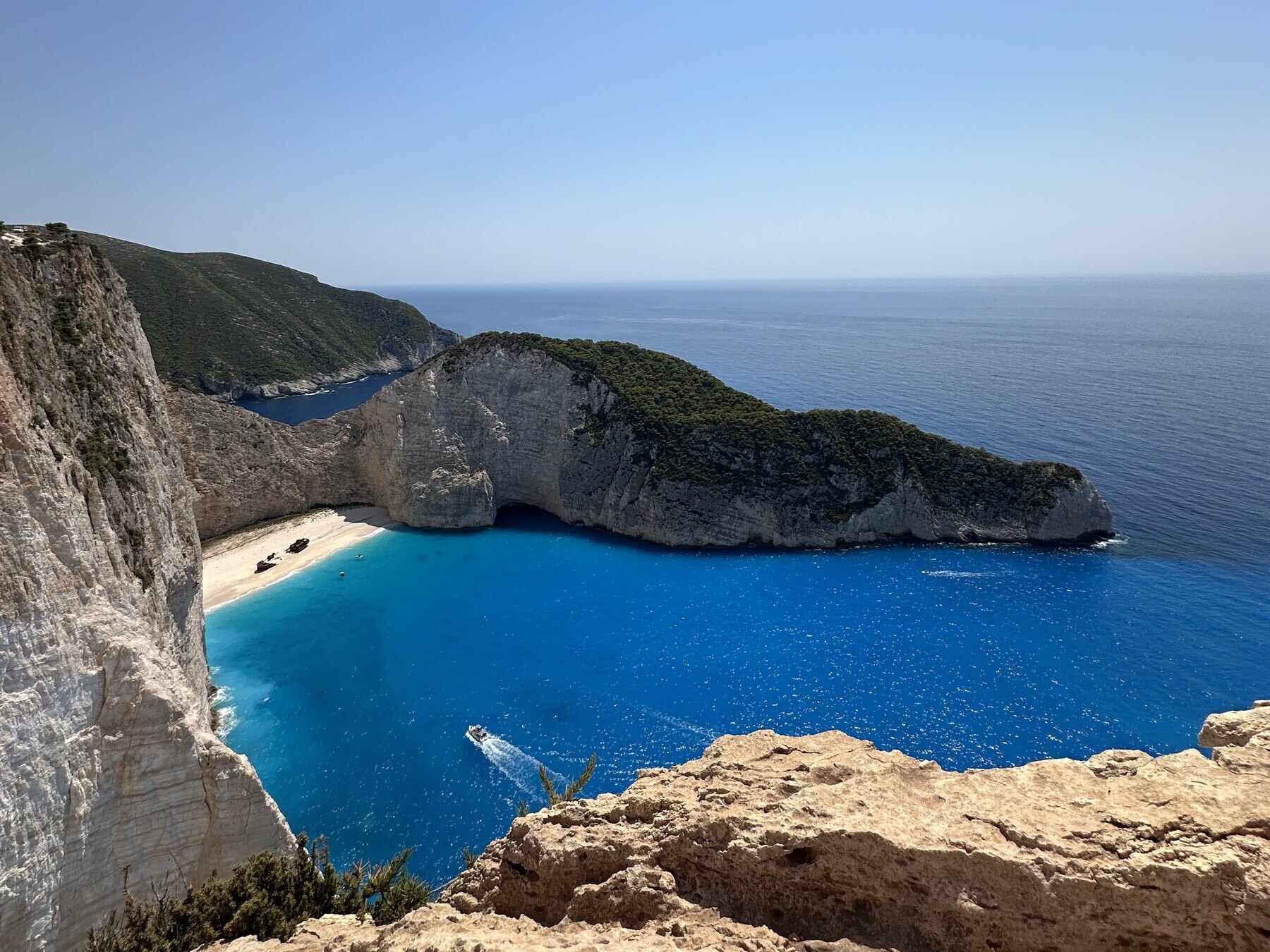
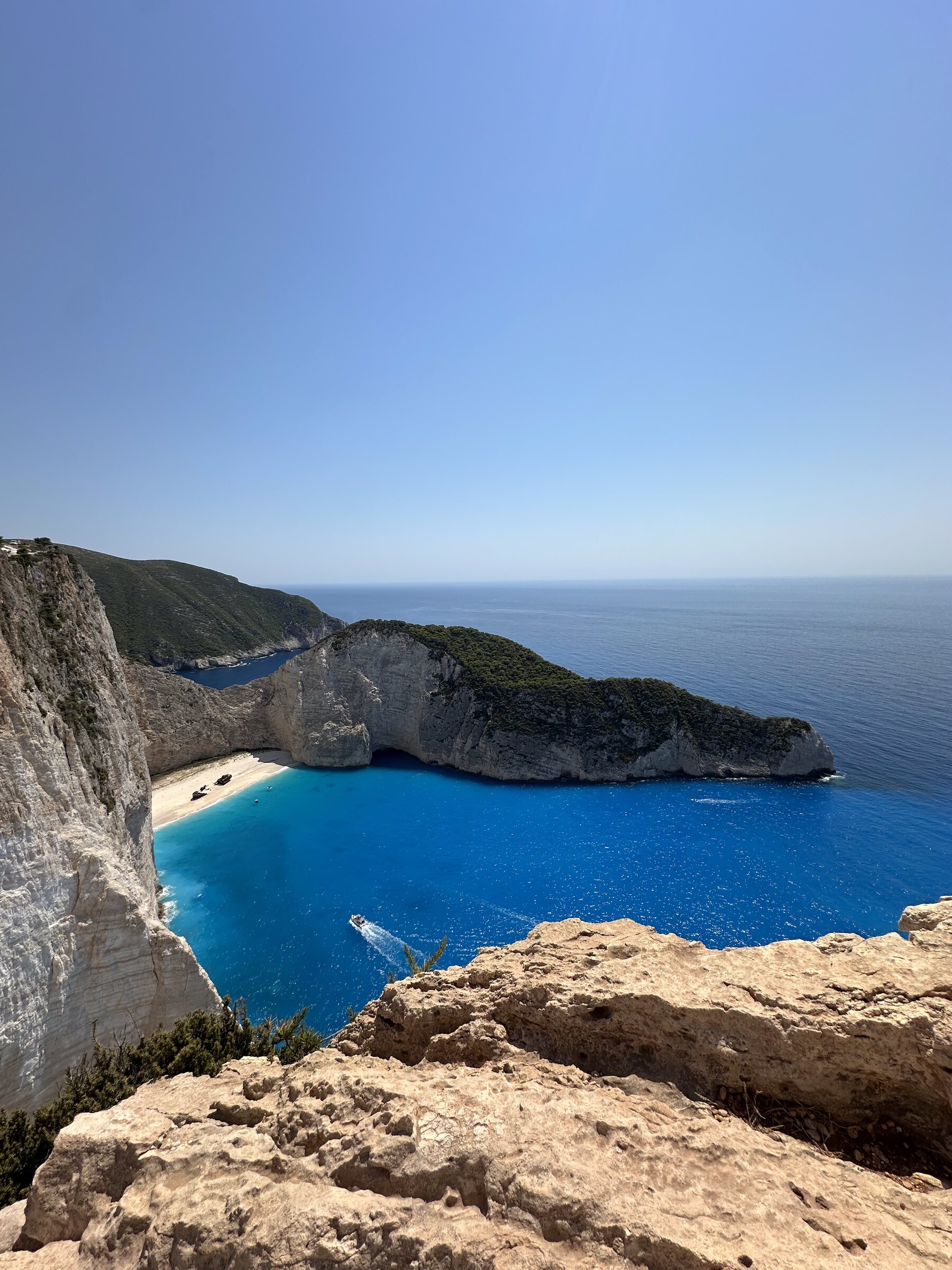
Navagio Bay from the cliff edge near Anafonitria, an excursion boat keeping its distance – Zakynthos in July 2025
West coast: rock fjords instead of sand – Porto Limnionas, Porto Roxa, Keri
The west coast of Zakynthos has not a single classic sandy beach – and that is exactly why it has the clearest coves. Porto Limnionas is a narrow rock fjord near Agios Leon: you climb down steps and concrete platforms to the water, hold on to a ladder and drop into deep turquoise water. No sand, no shade, no lifeguard, but a taverna with a terrace where you can rent sunbeds. With a mask you will see caves and rock arches under water. Not for children who cannot swim confidently yet; for everyone else one of the most beautiful swimming spots on the island.
A few kilometres on lies Porto Roxa: concrete terraces with sunbeds above the water, ladders into the sea, two or three tavernas – and in the evening the sun dropping straight into the Ionian Sea. In the far south-west, Keri waits with its lighthouse, cave boats and the quietest village on the island; the road there is winding but fine. Porto Vromi, finally, is less a beach than a harbour: a small patch of pebbles from which the Navagio boats depart.
Honestly: west coast means hairpin bends. Allow an hour for 30 kilometres, fill up beforehand and bring water – up in the villages there are kafenia, down at the coves often just the one taverna. And while you are in the west: the best comes at the next stop, up north.
North and north-east: Blue Caves, Xigia and Makris Gialos
At the northern tip of the island, around Cape Skinari and the harbour of Agios Nikolaos, lie the Blue Caves: rock arches and caves where the water glows so blue in the morning that every photo looks filtered. You can only get in by small boat; many operators combine the caves with the trip to the wreck. If you get seasick easily, take the bigger, slower boat.
A few kilometres south comes the curiosity: Xigia Beach. A pebble beach beneath cliffs whose water shimmers milky and smells of sulphur – springs bubble up under water. Some call it a natural spa, others wrinkle their nose. Try it, but rinse your swimwear well afterwards. Right next door is Makris Gialos, a small pebble cove with very clear water and tavernas up on the road – our tip for a quiet afternoon with mask and snorkel.
The north-east is also the side from which you see Kefalonia. And in clear air you understand why the 2022 earthquake between precisely these two islands changed so much.
South: the marine national park – Gerakas, Dafni, Kalamaki, Marathonisi
Laganas Bay in the south is a national park because the loggerhead turtle (Caretta caretta) nests here. That changes everything about a beach day – for the better. Gerakas at the tip of the Vasilikos peninsula is the most beautiful beach in the bay: fine sand, shallow water, no motorboats. The rules (as of 11/2026): access only from 7 am to sunset, completely closed at night from May to October; no private umbrellas or sunbeds, only the few spots approved by the park; during the nesting season you stay within five metres of the water, no digging, no building. At the car park at the top there is a kiosk where visitor numbers are limited in high season. The walk down takes five minutes.
Dafni lies at the end of a gravel road, has sand, two tavernas and little else – but the park’s visitor centre is nearby, where you learn when guided night-time turtle watching is offered. Kalamaki is the family beach: long, shallow, sunbeds only in marked zones, and in the evening everything is cleared from the sand so the animals have a free run. The island of Marathonisi (“turtle island”) can only be reached by boat; parts of its beaches are closed, swim stops in the coves are allowed. A sighting is never guaranteed – and operators promising “touch the turtles” are ones to avoid.
Honestly:Laganas itself – the town – is a party strip with bars down to the beach. The water there is lovely, the promenade is not. If you want peace, stay in Vasilikos, Keri or the north. How we pick beaches when travelling with kids is in Travelling with kids.
East: Banana Beach, Porto Zoro, Tsilivi – sand for everyone
The east coast is the sandy side. Banana Beach on the Vasilikos peninsula is one of the longest beaches on the island: wide sand, sunbed zones, beach bars, water sports – busy, but big enough to find your own corner at the edges. Porto Zoro and Agios Nikolaos Beach (not to be confused with the harbour in the north) are the smaller neighbours with shallow bays. Further north lies Tsilivi, a classic resort with a long, calm beach, tavernas and accommodation right behind the sand; in high summer the organised part is full, the edges stay quieter.
Accommodation in Vasilikos or Tsilivi is on Booking.com (ad); how we find the good holiday flats is explained in Booking Airbnb the right way. And wherever you stay: without a car you will not reach the good beaches. The next section shows why.
Getting to Zakynthos: ferry from Kyllini, flights, car on the island
Route
Duration
Cost (guide prices, as of 11/2026)
Note
Car ferry Kyllini – Zakynthos Town (Levante Ferries)
approx. 1 h 15 min
passenger from approx. €12.50, car from approx. €38
up to 7 sailings a day in summer, about 4 in winter – book ahead in July
Direct flights to Zakynthos (ZTH)
approx. 2–3.5 h from Central Europe and the UK
depends on season
seasonal (summer timetable); in winter via Athens
Rental car on the island
–
depends on season
a small car is enough; hairpins in the west, gravel to Dafni
Own car from Central Europe
approx. 1,500 km from Vienna to Kyllini
tolls, vignettes, ferry
via Croatia, Montenegro, Albania – or ferry Ancona/Bari – Patras
Sources: Levante Ferries / ferryhopper.com (ferry prices and frequency, as of 11/2026), our own crossing on 14 July 2025. Check flight connections in the current timetable before booking.
We came with our own car in July 2025 – as a leg of our 40-day road trip across the Balkans: ferry from Kyllini on the Peloponnese, a good hour’s crossing, arrival in the port of Zakynthos Town. In high summer car spaces on the ferry are scarce, so book ahead. If you fly, compare flights on Kiwi.com (ad) and pick up a rental car at the airport – for example via Discover Cars (ad). The airport is at Kalamaki, right next to the marine park: night flights are restricted during the nesting season, so do not be surprised by unusual flight times.
One more thought for road-trippers: from Ksamil in Albania to the ferry in Kyllini it is about five to six hours plus the border. Combine the Albanian Riviera with Zakynthos and you get two completely different coasts in one week – more in Albania: the sights that are really worth it.
Best time to go and what a beach day costs
May, June and September are the best months: warm enough to swim, without the July heat. In July and August it is crowded – we lived it: sunbed next to sunbed on the east coast, queues at the Navagio platform at midday, ferries sold out. In return the warmth lasts into October, and the sea is warmest in September. In winter ferries run less often, many tavernas are closed, and the turtles are gone.
What a beach day costs (guide prices, our experience in July 2025 and 2026 figures): a pair of sunbeds with umbrella roughly €10 to €20 depending on the beach, at rock coves like Limnionas as a minimum spend at the taverna. Boat trip to the wreck from Porto Vromi roughly €15 to €30, with the Blue Caves €40 to €70. Parking is free at most beaches. If you do the maths: a day at Gerakas with your own towel costs nothing but fuel. How to pay abroad cheaply without giving away ATM fees is explained in Money abroad.
Mistakes & traps on Zakynthos
Booking Navagio “with beach time”. No boat may land in 2026. Reputable operators say so.
Gerakas in the evening. It closes at sunset and is off-limits at night – staying risks a fine and disturbs nesting animals.
Your own umbrella in the marine park. Not allowed at Gerakas and in the nesting zones; use the approved spots or your towel.
Touching or chasing turtles. Boat operators promising this break the park rules – and you pay for it too.
A quad without experience. The west-coast hairpins and the gravel to Dafni are no place for a first ride. A small car is safer and often no more expensive.
A spontaneous ferry in high summer. Car spaces Kyllini – Zakynthos go fast in July; book online in advance.
No water shoes. Limnionas, Xigia and Makris Gialos are pebbles and rock – a cheap pair of water shoes saves the day.
All avoided? Then only one decision remains: which cove tomorrow. Our suggestion: Gerakas at seven, Limnionas in the afternoon, Porto Roxa for sunset.
Entry & visa – official websites only
Greece is part of the EU and the Schengen area. EU citizens need a valid passport or national ID card, children need their own document, and no visa is required. Austrian travellers find current advice on safety, the wildfire season and traffic on bmeia.gv.at → Reiseinformation → Griechenland. If you drive in via Albania, mind your car insurance’s Green Card and the summer border queues – details in our Balkans road trip. Travellers without an EU passport (UK, US, Canada, Australia and others) should read about the Entry/Exit System (EES) and the ETIAS travel authorisation exclusively on travel-europe.europa.eu, the EU’s official website (as of 11/2026).
Warning: There are broker websites charging several times the real price for ETIAS, “entry permits” or supposed beach tickets. We once fell for a site like that ourselves – since then: official websites only, type the address yourself, never via an ad. In the guide you will find all official links as QR codes; the Frangipani guide “Greek islands: Zakynthos, Mykonos, Santorini” compares the three islands and tells you which one fits you.
Checklist: beach days on Zakynthos
☐ Rental car or your own car – you will not reach the good beaches without one
☐ Ferry Kyllini – Zakynthos booked ahead for July/August
☐ Navagio status checked (Municipality of Zakynthos, operators): in 2026 boat at a distance or platform only
☐ Planning Gerakas before 7 am? Then wait – access only from 7 am to sunset
☐ Water shoes, mask and snorkel for Limnionas, Xigia, Makris Gialos
☐ Own towel instead of umbrella in the marine park, cash for sunbeds at the rock coves
☐ Water and snacks for the west-coast hairpin programme, tank filled beforehand
☐ Sun protection: there is no shade at the rock coves
Frequently asked questions about Zakynthos beaches
Is Navagio Beach open in 2026?
No. Until at least 31 October 2026 entering the beach and swimming in the cove are prohibited, and boats must keep 50 metres away. You can see the wreck from a boat and – once the safety works are complete – from the platform near Anafonitria. No decision has been made for 2027 yet (as of 11/2026).
Which beach on Zakynthos is the most beautiful?
For sand and families Gerakas, for clear water and snorkelling Porto Limnionas and Makris Gialos, for sunset Porto Roxa. Navagio remains the most spectacular sight – but only from a distance.
Can you see sea turtles on Zakynthos?
Yes, with some luck on boat trips in Laganas Bay around Marathonisi, from May to October. Nesting animals on land are off-limits: beaches like Gerakas are closed at night, and the park’s visitor centre has information on guided observations.
How do I get from Kyllini to Zakynthos?
By Levante Ferries car ferry in about 1 hour 15 minutes to Zakynthos Town; up to seven sailings a day in summer, passengers from approx. €12.50, cars from approx. €38 (as of 11/2026). Book ahead in July and August.
Do you need a car on Zakynthos?
Yes. The beaches are far apart, buses are rare and do not go to the rock coves in the west. A small car is enough; quads on the hairpins are for experienced riders only.
When is the best time for a beach holiday on Zakynthos?
June and September: warm sea, fewer people, all tavernas open. July and August are hot and crowded but have the longest days. From November to April it is low season with few ferries and closed beach facilities.
Joint Ministerial Decision on Navagio Bay, Government Gazette, June 2026 – as reported by To Vima (2 June 2026) and greece-trips.com (checked 14 July 2026)
Wikipedia: Navagio Beach – history of the Panagiotis (1980), rockfall 2018, earthquake and landslide 09/2022, OASP recommendation 2023
Rules of the National Marine Park of Zakynthos (Gerakas: access 7 am to sunset, nesting season May–October) – park information, summarised on beachverdict.com (checked 11/2026)
Levante Ferries / ferryhopper.com – ferry Kyllini–Zakynthos: duration, prices, frequency
Bangkok rainy season May–October: wettest month September (336 mm), usually 1–2 h of afternoon rain. Climate table, day plan, transport, den…
10 Nov 2026 · 12 min read
Let me know when the guide is out
🔔 Get new articles & deals as a notification?No spam – max. 4 a day, switch off anytime.
Your choice
We only use what is necessary to run this website. Everything else – such as statistics or content from third parties – only with your consent. You can change your choice at any time.