Short answer:Erfurt in one day works entirely on foot – the old town is compact, and the cathedral square is less than 20 minutes from the main station. The best order: Anger → Fischmarkt → Krämerbrücke (Merchants’ Bridge) → Jewish quarter → Domplatz with cathedral and St Severus → Petersberg Citadel for sunset. Plan 6 to 8 hours, about 6 kilometres and very little money: the bridge, the cathedral and the citadel plateau are free. Important for 2026/27: the Old Synagogue is closed for restoration from 3 August 2026 until an expected 28 February 2027 (source: Erfurt Tourism, as of 11/2026).
8:40 am, Erfurt main station. The ICE rolls on towards Berlin, you stay on the platform and hear, for the first time, how quiet a state capital can be. A tram bell, pigeons, nothing else. Ten minutes later you are standing on the Anger, and above the rooftops two towers appear – not one but two, the cathedral and St Severus, shoulder to shoulder on a hill. That is where your day ends. In between lie a bridge people live on, a 900-year-old house of worship and, if you ask anyone from Thuringia, the best bratwurst in Germany.
Plan this tripOur go-to links for a place to stay, rental cars, mobile data and travel gear:
In this article: a walking route with a timetable you can simply follow in this order – with opening hours, prices and sources, honest notes on what you can skip, and a checklist for the day. We have visited Erfurt ourselves; what we made of it is in our post Erfurt things to do.
Erfurt in one day: the timetable at a glance
Time
Stop
Duration
Cost
9:00
Anger and Kaufmannskirche
30 min
free
9:30
Fischmarkt with town hall, Haus zum Breiten Herd
30 min
free
10:00
Krämerbrücke and Wenigemarkt
45 min
free (St Giles’ tower for a small donation)
10:45
Jewish quarter: Old Synagogue (outside), Stone House, mikveh
45 min
Old Synagogue €8 / €5 reduced – closed until an expected 28 Feb 2027
11:45
Lunch: Thuringian bratwurst on Domplatz
45 min
a few euros
12:30
St Mary’s Cathedral and St Severus
60 min
free entry, guided tour €4.50
13:30
Petersberg Citadel: plateau, view, exhibition
90 min
plateau free; exhibition €8, listening-tunnel tour €8
15:00
Coffee in the old town, Augustinian Monastery (optional)
60 min
monastery grounds free
16:30
Back to the Petersberg or the bridge in evening light
until departure
free
Prices and times: Erfurt Tourism (Old Synagogue, as of 11/2026), Petersberg Citadel information leaflet (2024 edition, check on site), kribbelbunt.de on the cathedral (hours, tour prices). Total distance about 6 km.
Sounds like a lot? It isn’t. No two stops are more than ten minutes apart on foot. And the first of those minutes starts right outside the station.
9:00 – Anger: the starting point everyone underrates
From the main station, walk straight up Bahnhofstraße and after about ten minutes the Anger opens up: a long square, once the wool and woad market, today a shopping street with Art Nouveau façades and the Angermuseum in a baroque customs house. Most visitors rush through. Do it differently: stop briefly in front of the Kaufmannskirche at the top end. Johann Sebastian Bach’s parents married here in 1668 – Erfurt was a Bach town for generations, long before Leipzig was.
A word about the Puffbohne, the broad bean: Erfurters call themselves that, after the bean once grown all around the city. You will meet it all day as a figurine, a biscuit and a souvenir. Now on you go – turn left into the lanes that get narrower and older with every step.
9:30 – Fischmarkt: town hall, Renaissance and the first goosebumps
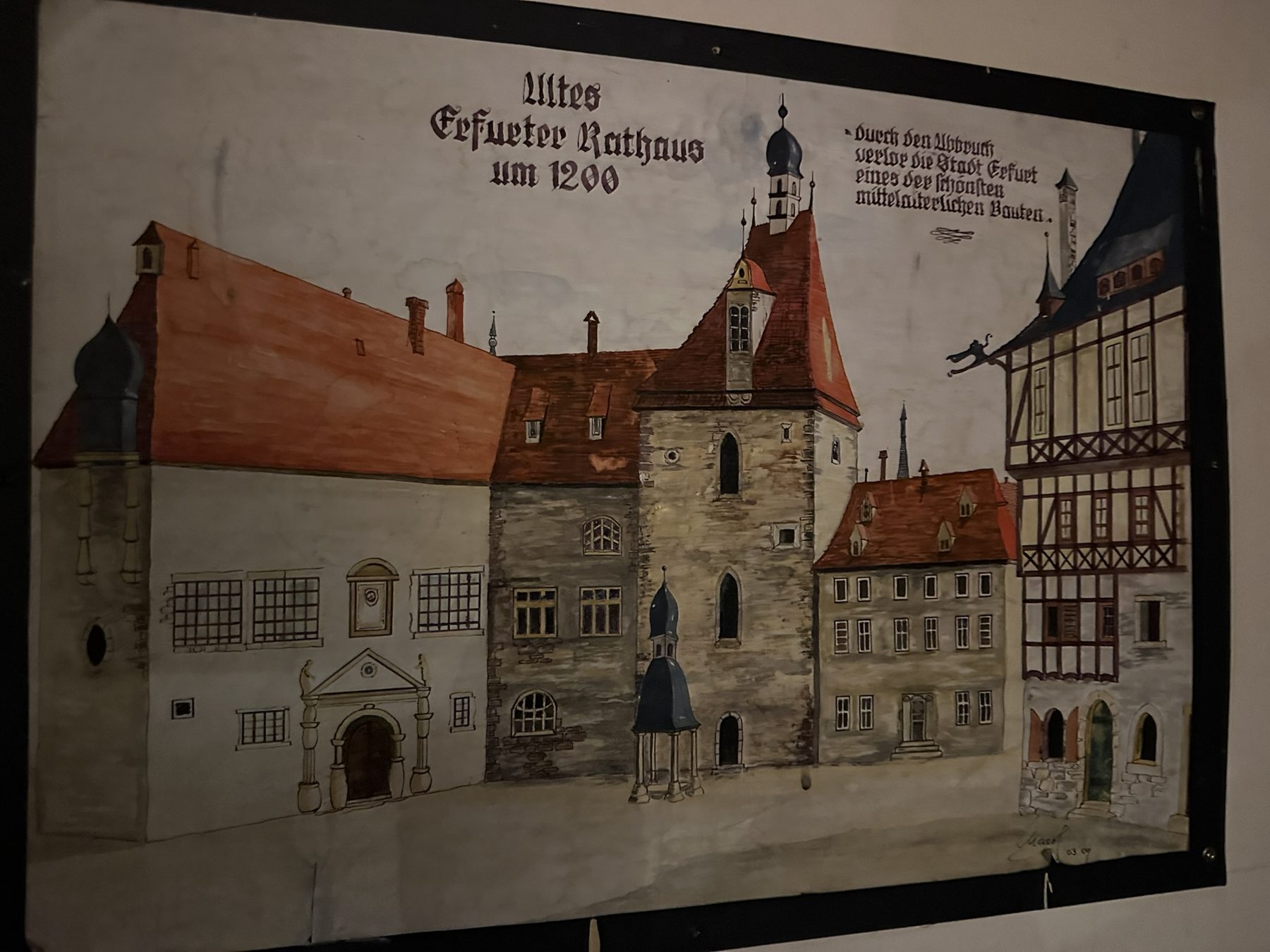
The Fischmarkt is Erfurt’s most beautiful square, and it has little competition. On the left the neo-Gothic town hall from the 1870s, opposite it the Haus zum Breiten Herd of 1584 with its frieze of the five senses, next to it the house Zum Roten Ochsen of 1562. In the middle stands the Römer, a Roland statue from 1591 – Erfurt’s symbol of civic freedom. At half past nine in the morning you almost have the square to yourself. The light falls flat across the gables, and you suddenly understand why Erfurt suffered less wartime destruction than almost any other large German city and today has one of the best-preserved medieval old towns in the country.
Behind the town hall you hear water. That is the river Gera. And across the Gera runs the bridge you really came for.
10:00 – Krämerbrücke: the bridge people live on
At first you don’t even notice you are on a bridge. Half-timbered houses left and right, shops selling indigo-dyed cloth, chocolate, ceramics and Thuringian mustard, cobblestones, cats in between. Only from the riverbank do you see it: the Krämerbrücke carries 32 houses and is the longest continuously built-on and inhabited bridge in Europe. About 80 people live up here.
The figures behind it (source: Wikipedia, as of 11/2026): the earlier wooden bridge burned down seven times between 1175 and 1293; the stone bridge was completed in 1325. After the great town fire of 1472 the houses were rebuilt – originally 62 narrow stalls that over time merged into 32 houses. The bridge is about 120 metres long, and the lane between the houses just 5.5 metres wide. At the eastern end stands St Giles’ Church (Ägidienkirche), first mentioned in 1110; from its tower you see the bridge from above – the climb is available for a small donation, with times posted on the door.
Honestly: the bridge is short. Plan 30 to 45 minutes including the tower and a look from the riverbank below the Wenigemarkt, not half a day. But the small detour pays off: at the eastern end, turn right and go down to the water. From there you see the backs of the houses hanging out over the river – that is the photo you are looking for.
From the Wenigemarkt it is less than five minutes to a quarter that made the whole world look at Erfurt in 2023.
10:45 – Jewish quarter: UNESCO World Heritage since 2023
In September 2023, UNESCO declared three buildings in Erfurt World Heritage: the Old Synagogue (Waagegasse 8), the medieval mikveh at Kreuzsand and the Stone House on Benediktsplatz. The synagogue is considered one of the oldest, largest and best-preserved medieval synagogues in Europe; its oldest parts date back to the 11th century. Until 2026 its cellar housed the Erfurt Treasure: 3,140 silver coins, 14 silver ingots, around 700 pieces of goldsmiths’ work from the 13th and 14th centuries, and a Jewish wedding ring of which only two others from that period are known worldwide (source: Erfurt Tourism).
Important for your planning: the Old Synagogue is closed for restoration from 3 August 2026 until an expected 28 February 2027, and the treasure cannot be seen during that time. Normally it is open Tuesday to Sunday, 10 am to 6 pm, €8 per person, €5 reduced, audio guide included (as of 11/2026, erfurt-tourismus.de). While it is closed, the walk is still worth it: Waagegasse itself, the Stone House from outside and the entrance to the mikveh (visits only with a guided tour via Erfurt Tourism) tell the story even without a ticket. From March 2027 the synagogue belongs firmly back in this timetable – check current hours before you travel.
Now your stomach is rumbling. Good, because the next square smells of charcoal.
11:45 – Lunch: Thuringian bratwurst on Domplatz
You smell the Domplatz before you see it. Thuringian Rostbratwurst is an EU-protected speciality and is eaten here the way it should be: from a charcoal grill, in a bread roll, with Thuringian mustard – ketchup counts as an insult to many. A stall on the square, a roll in your hand, your eyes on 70 steps and two towers: that is the Erfurt moment you take home. If you would rather sit, the taverns around Domplatz and the Wenigemarkt serve Thuringian dumplings and roulades. Expect a few euros for bratwurst and a drink, and the usual German city prices for a sit-down lunch.
And if you are here in Advent: the square is full of stalls, and the cathedral steps are the best grandstand for the Christmas market. All the dates are in our post on the Erfurt Christmas market 2026.
12:30 – St Mary’s Cathedral and St Severus: 70 steps, one bell, two churches
The cathedral steps – 70 of them – lead up the Domberg, where the cathedral and St Severus stand so close together that from a distance they look like a single building. In the cathedral’s central tower hangs the Gloriosa, cast in 1497 and one of the largest free-swinging medieval bells in the world. It rings only on major feast days – if you hear it, you are lucky. Inside, the choir stalls, the tall choir windows and the view back down the nave are worth your time.
The figures (source: kribbelbunt.de, as of 11/2026): entry is free. Opening hours November to April: Monday to Saturday 9:30 am to 5 pm, Sundays and holidays 1 pm to 5 pm; May to October until 6 pm. Public guided tours €4.50 per person. Right next door, St Severus, entirely late Gothic, holds the sarcophagus of Saint Severus – usually quieter than the cathedral and just as free to enter.
You are now standing at the place from which you saw the two towers this morning. But the best view of them is still to come – from the other side of the square, a few metres higher up.
13:30 – Petersberg Citadel: the fortress above the town
From Domplatz a path leads up to the Petersberg in a few minutes. On top lies one of the largest and best-preserved baroque town fortresses in Europe, begun in 1665 under the Electorate of Mainz and reconstructed piece by piece since 1990. The plateau with its ramparts, bastions and the Romanesque St Peter’s Church is freely accessible; a step-free panorama path and a lift lead up. And then you stand at the parapet and there it is: the view over the entire old town, cathedral and St Severus directly opposite, the roofs stretching back to the Anger.
If you want to go deeper: the commandant’s house holds the interactive exhibition “Der Petersberg – eine spannende Zeitreise” (according to the 2024 leaflet: €8, reduced €4, seniors €6, combined ticket with St Peter’s Church €12, daily 10 am to 6 pm). More exciting are the listening tunnels (Horchgänge): underground passages in which defenders once listened for enemy mining – one-hour guided tour €8, reduced €4, in winter daily at 2 pm; inside it is 10 to 15 °C all year, so bring a jacket. All details come from the citadel’s information leaflet (2024 edition) – check current prices and times on site or with Erfurt Tourism.
Advertising: affiliate links – if you book through them we earn a small commission; your price stays the same.
15:00 – Coffee, the Augustinian Monastery and an afternoon to taste
Back in the old town you have three options, depending on what grabs you:
History: the Augustinian Monastery north-east of the Krämerbrücke – Martin Luther lived here as a monk from 1505 to 1511. Cloister and church are quiet; Luther’s cell is seen on a guided tour, with times and prices on the monastery’s website.
Flowers: tram line 2 towards Messe takes you to the egapark in about 20 minutes, one of Germany’s largest garden parks with Europe’s largest ornamental flower bed, an observation tower and the Danakil desert-and-rainforest house. Check prices and season on egapark-erfurt.de – in winter the bed is empty, but from November there is the “Winterleuchten” light show.
Nothing at all: a café on the Wenigemarkt, Schittchen (Erfurt’s name for its Christmas stollen) in winter, ice cream in summer, and watching the light move across the Krämerbrücke.
Whatever you choose: be back on the Petersberg or on the riverbank below the bridge by 4:30 pm. The evening light is the reason you should not leave on the first train.
Getting to Erfurt: as central as it gets
Erfurt lies almost exactly in the middle of Germany, and its ICE hub makes a day trip easy. The main connections (approximate, 2026 timetable – check bahn.de):
From
Journey time (approx.)
Note
Leipzig
under 1 hour
ICE, frequent service
Berlin
about 2 hours
direct ICE
Frankfurt am Main
about 2 to 2.5 hours
direct ICE
Munich
about 2.5 hours
ICE via Nuremberg
Vienna
about 7 to 7.5 hours
direct ICE service, 494 km (source: zug-ticket-kaufen.de, as of 11/2026)
By car: Erfurt sits on the A4 and A71 motorways; the old town is largely traffic-calmed, with car parks at Domplatz and around the Anger. If you are coming from Austria, combine Erfurt with Weimar and Wartburg Castle – then you will need an overnight stay. How we planned Thuringia with a thermal spa is in our Frangipani Guides; the Erfurt & Thuringia guide with all maps and official links as QR codes is in the works.
Entry & visa – official websites only
Erfurt is in Germany, which means the EU and the Schengen area. For Austrians, Swiss and all EU citizens that means no visa: a valid ID card or passport is enough. The reliable source for Austrians is the Foreign Ministry’s travel information: bmeia.gv.at – travel information Germany.
If you are travelling from outside the EU (for instance the USA, the UK or Canada), the new Entry/Exit System (EES) and, in future, ETIAS apply. Inform yourself only on the official EU site travel-europe.europa.eu (as of 11/2026: EES is rolling out in stages; ETIAS, according to the EU, from the last quarter of 2026 with a €20 fee – check before you travel).
Warning about rip-off sites: search for “apply for ETIAS” and you quickly land on intermediary sites charging many times the official fee, or selling forms to travellers who need nothing at all. We fell for one of those ourselves once – hence our firm rule: use only government sites (.gv.at, .europa.eu, embassies), never start from a Google ad. In the guide you’ll find all official links as QR codes.
Checklist: Erfurt in one day
☐ Book train tickets early (saver fares), arrive by 9 am, leave no earlier than 6 pm
☐ Comfortable shoes – about 6 km of cobblestones and 70 cathedral steps
☐ A jacket for the listening tunnels (10–15 °C) and the Petersberg in the evening
☐ Check: Old Synagogue closed until an expected 28 Feb 2027 – from March 2027 check new hours
☐ Cathedral: November to April until 5 pm, Sundays from 1 pm only – swap the route if necessary
☐ Cash for the bratwurst stall and St Giles’ tower
☐ Check the Erfurt Card with Erfurt Tourism if you want several museums
☐ Travellers from outside the EU: EES/ETIAS only on travel-europe.europa.eu
If this grabs you, read next: Erfurt things to do – including what we found overrated – or our Vienna hidden gems if you want another old town to explore on foot.
FAQ: Erfurt in one day
Is one day enough for Erfurt?
For the old town, yes. The Krämerbrücke, Fischmarkt, Domberg, Jewish quarter and Petersberg are all within walking distance. With the egapark, a monastery tour and the thermal spa in Hohenfelden, an overnight stay is more relaxed.
How much does a day in Erfurt cost?
Very little: the Krämerbrücke, cathedral, St Severus and the citadel plateau are free. With the Petersberg exhibition (€8), the listening-tunnel tour (€8) and a bratwurst you reach about €20 per person excluding travel (as of: 2024 leaflet / 11/2026).
Is the Old Synagogue open in 2026?
No. According to Erfurt Tourism it is closed for restoration from 3 August 2026 until an expected 28 February 2027. After that, the usual hours apply again: Tuesday to Sunday 10 am to 6 pm, €8 per person.
What is the best order for the route?
From the station via Anger, Fischmarkt and Krämerbrücke to Domplatz, and the Petersberg last. That way you end with the panorama in evening light and are back at the station in 15 minutes.
Is Erfurt worth it in winter?
Yes, especially in Advent: the Christmas market on Domplatz, with the cathedral and St Severus as a backdrop, is among the most beautiful in Germany. Note the shorter cathedral hours (until 5 pm) and dress warmly for the Petersberg.
Do I need a visa for Erfurt?
Not from Austria, Switzerland or the EU – an ID card or passport is enough (bmeia.gv.at). Travellers from outside the EU should check EES and ETIAS only on travel-europe.europa.eu.
Erfurt is a city with nothing to prove. No queues, no timed tickets, no 45-minute metro ride between two sights. Instead, a bridge people live on, a cathedral whose bell has hung there since 1497, and a fortress plateau from which you look back in the evening on everything you walked during the day. When you stand on the platform and the train pulls in, you will catch yourself thinking about the path down to the water – and about that bread roll with mustard. That is exactly the point at which a day trip turns into your next journey.
Bangkok rainy season May–October: wettest month September (336 mm), usually 1–2 h of afternoon rain. Climate table, day plan, transport, den…
10 Nov 2026 · 12 min read
Let me know when the guide is out
🔔 Get new articles & deals as a notification?No spam – max. 4 a day, switch off anytime.
Your choice
We only use what is necessary to run this website. Everything else – such as statistics or content from third parties – only with your consent. You can change your choice at any time.