Bangkok 3 Days Itinerary: The Perfect Route with Temples, Chinatown and Honest Costs
9 Nov 2026 · 16 min read
Quick answer: A 3-day Bangkok itinerary works best by neighbourhood: Day 1 the old town by the river – Grand Palace (500 baht, from 8:30, ticket sales until 15:30), Wat Pho (300 baht) and Wat Arun (200 baht) by boat. Day 2 Golden Mount (100 baht), Jim Thompson House (250 baht), Talat Noi and Chinatown. Day 3 Chatuchak Market (Sat/Sun only) or Lumphini Park, skyline in the evening. From Suvarnabhumi Airport the Airport Rail Link costs 15–45 baht, the orange-flag express boat 17 baht. The biggest trap in 2026: the TDAC digital arrival card is free on tdac.immigration.go.th – copycat sites charge money. Since 15 September 2026, German citizens get only 30 days visa-free.
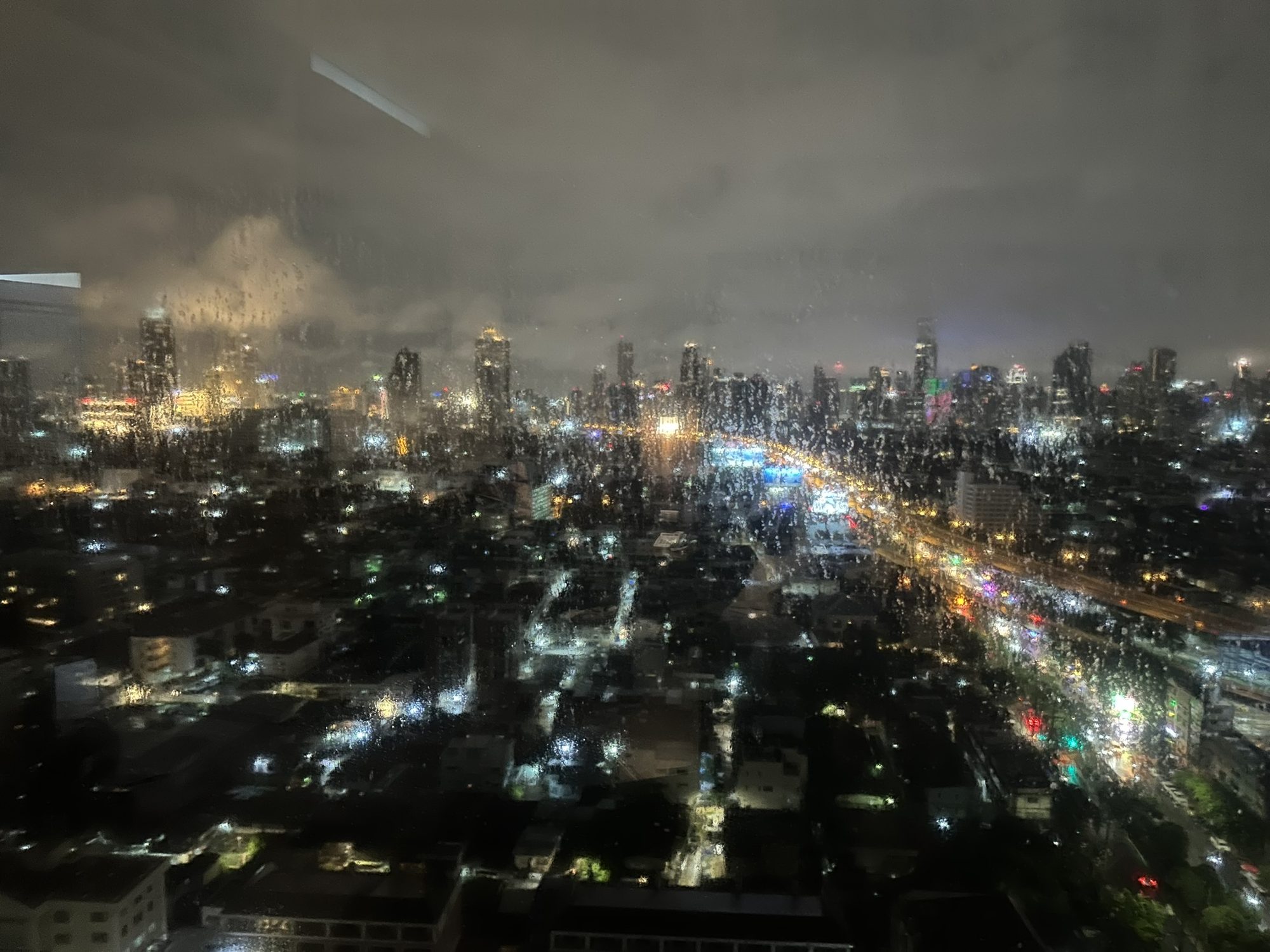
You never forget your first night in Bangkok. You stand at the window of a hotel on the twentieth floor, the air conditioning humming, and below you lies a city that never stops glowing. Elevated highways run like veins of light through the dark, somewhere a temple roof flashes gold. And the next morning a tropical downpour suddenly hammers against the glass as if someone had emptied a bucket – twenty minutes later the asphalt is steaming and the city is loud, hot and full of smells again: lemongrass, traffic, grilled meat.
Plan this tripOur go-to links for a place to stay, rental cars, mobile data and travel gear:
That is how we experienced Bangkok: overwhelming, chaotic and more beautiful than you would expect from a metropolis of ten million people. But also a city where you can lose a lot of time and money in a single day – to the wrong tuk-tuk driver, the wrong website and the wrong time of day. In this post you get a Bangkok 3 days itinerary that really works on foot, by boat and by train, with checked entrance fees, the official cheap options and the traps you can skip.
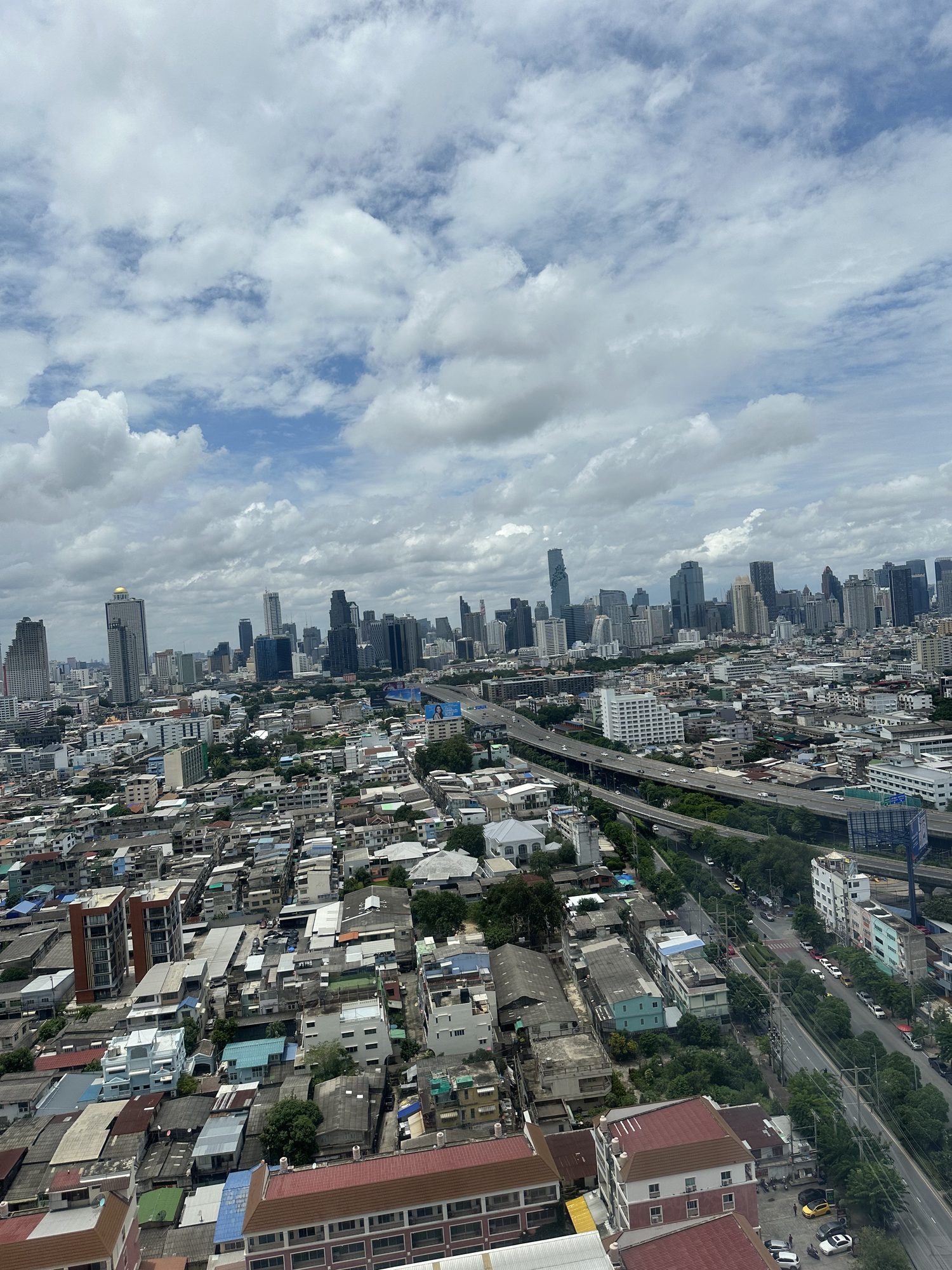
Bangkok from above – our own photo from our hotel. This is the size of the city you’ll get to know in three days.
Bangkok 3 days itinerary at a glance
The most important rule for Bangkok: plan by neighbourhood, not by a list of sights. Anyone trying to go from the Grand Palace to Chatuchak and back to Khao San Road in one day spends half the time in traffic. Our itinerary bundles one area per day.
Day
Morning
Afternoon
Evening
Day 1 – Old town & river
Grand Palace & Wat Phra Kaew (early!)
Wat Pho, then ferry to Wat Arun
Sunset by the river, dinner on the bank
Day 2 – Hill & Chinatown
Golden Mount (Wat Saket)
Jim Thompson House or Talat Noi
Street food on Yaowarat Road
Day 3 – Markets & green
Chatuchak (Sat/Sun) or Lumphini Park
Break at the hotel, massage
Skyline from a rooftop or a river ride
Swap day 3 to the front if you arrive on a weekend – Chatuchak Weekend Market is only open on Saturday and Sunday.
Day 1: Grand Palace, Wat Pho and Wat Arun – Bangkok’s golden heart
8:30 – Grand Palace and Wat Phra Kaew
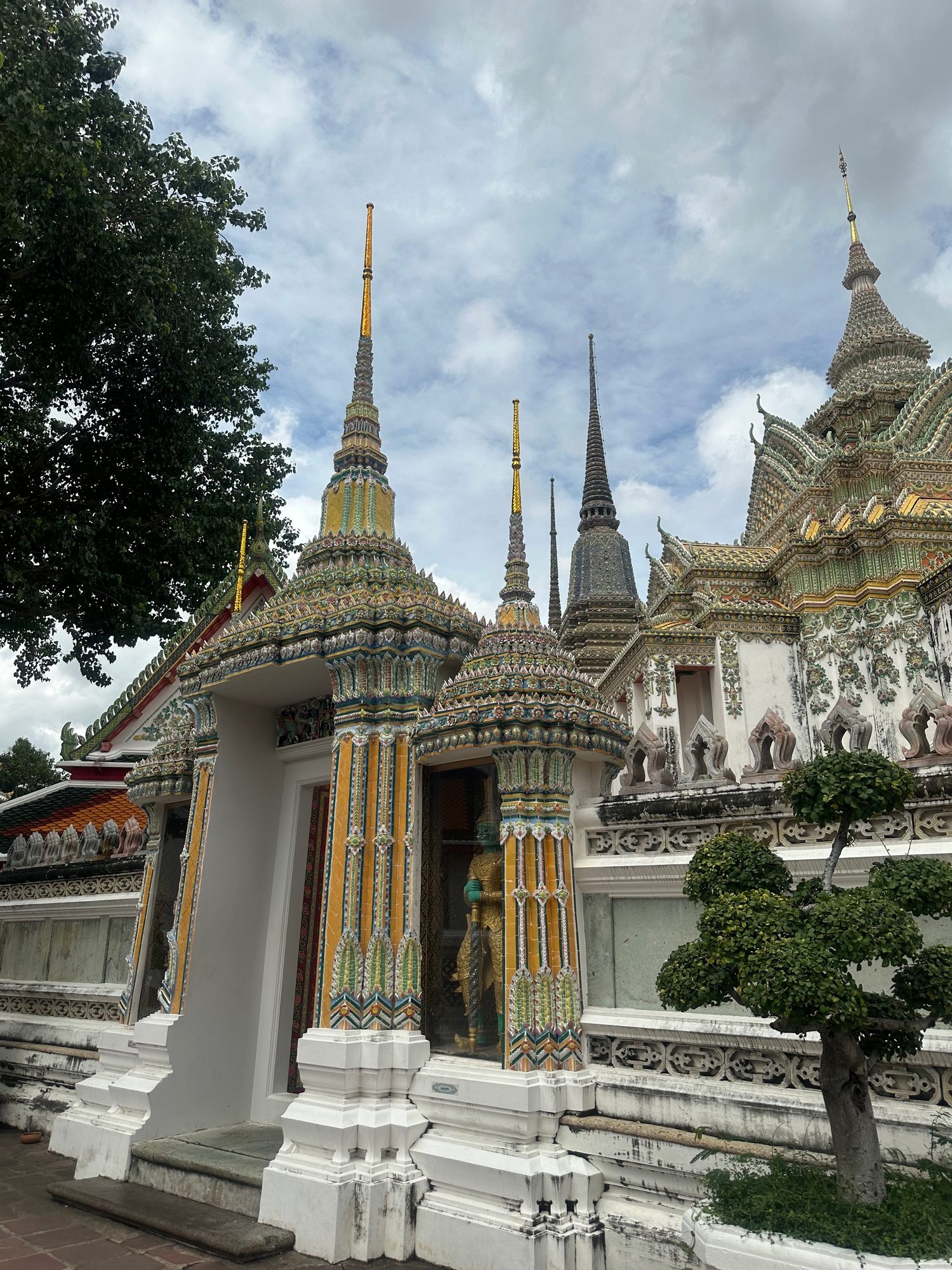
Be there when it opens. At half past eight the first tour groups are still at their buses, and for a moment you almost have the golden chedis, the colourful guardian figures and the Temple of the Emerald Buddha to yourself. From ten it gets crowded, from midday the sun bounces back off the white paving. Admission is 500 baht; according to a current overview, ticket sales run from 8:30 to 15:30. The ticket also covers the Queen Sirikit Museum of Textiles.
Dress code: shoulders and knees covered, no see-through fabrics. If you turn up in shorts, you’ll have to borrow or buy something at the entrance – which costs time. A light scarf and long, airy trousers in your daypack solve the problem for the whole day.
11:00 – Wat Pho and the Reclining Buddha
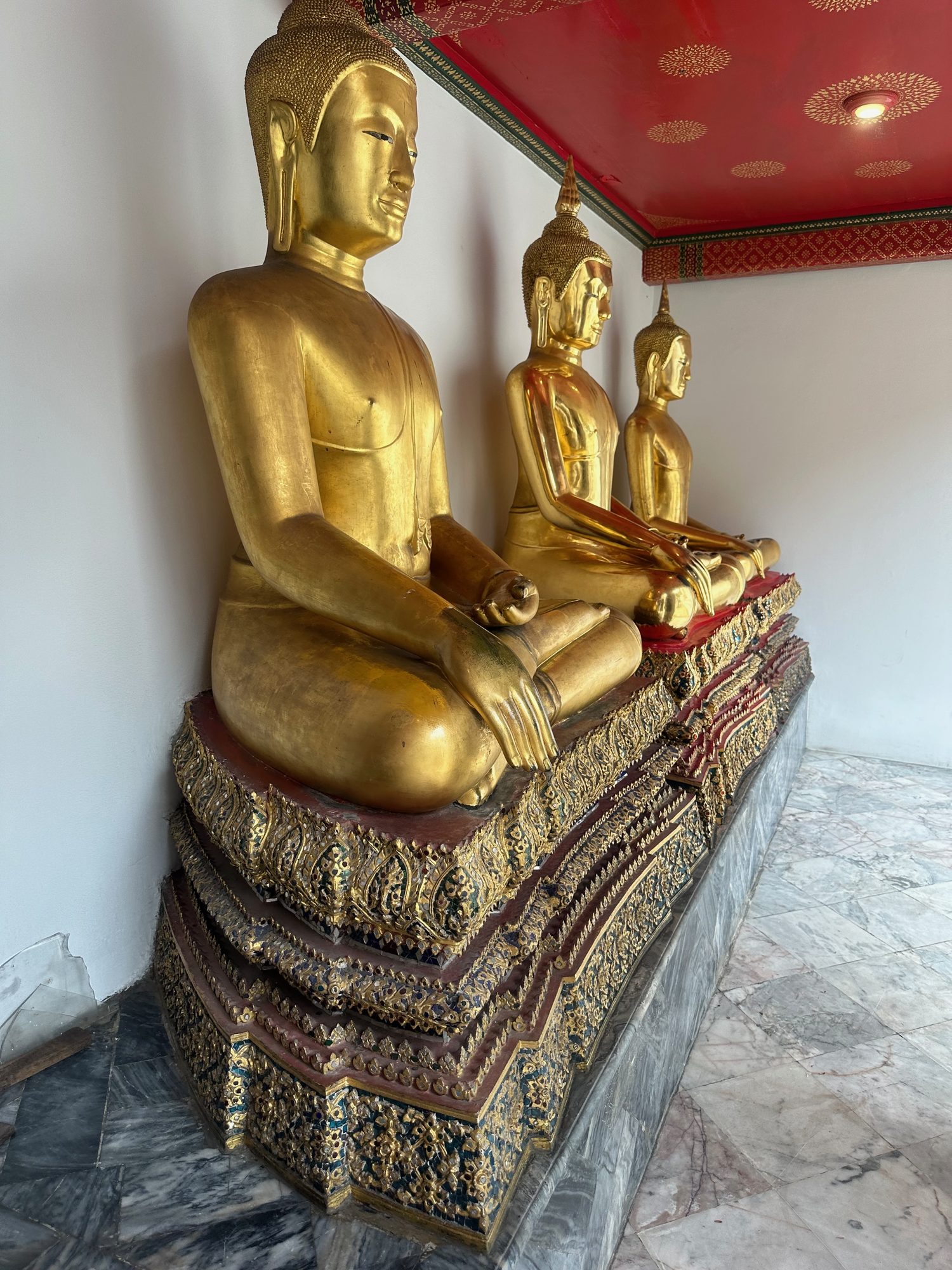
Just a few minutes’ walk south is Wat Pho, for us the most beautiful temple in Bangkok. The huge Reclining Buddha is the famous photo, but what stays with you are the quiet courtyards behind it: rows of golden Buddha statues in long galleries, colourfully glazed chedis, an old Bodhi tree where people pray. Admission is 300 baht, children under 120 cm go free. It opens at 8:00; for closing time sources give 18:30 or 19:30 – better plan with the earlier one.
14:00 – Ferry to Wat Arun
From Tha Tien pier right next to Wat Pho, a small ferry crosses the Chao Phraya to Wat Arun, the Temple of Dawn. The crossing takes only a few minutes. Admission is 200 baht, last tickets are sold around 17:40 according to the overview. Wat Arun is actually most beautiful from the other side: after your visit, cross back and sit on the bank near Tha Tien in the late afternoon, and you’ll watch the sun set behind the temple as its porcelain mosaic lights up gold.
Evening: stay by the river. Around Tha Tien and Tha Maharaj there are restaurants with water views. If you’re tired, take the boat back towards Sathorn.
The quiet galleries of Wat Pho – our own photo. This is where Bangkok suddenly goes silent.
Day 2: Golden Mount, Chinatown and Talat Noi
Morning – Golden Mount (Wat Saket)
The Golden Mount used to be the highest point in the city; today it’s the most beautiful quiet viewpoint in the old town. You spiral up around three hundred steps past bells and small waterfalls, and at the top Bangkok spreads out in every direction. The climb costs 100 baht, and it’s open roughly 7:30 to 19:00 according to a current overview. Come early, before the heat builds.
Midday – Jim Thompson House
The Jim Thompson House is a group of traditional teak houses set in a tropical garden, just a few steps from BTS National Stadium. It tells the story of the American who made Thai silk world-famous and vanished without trace in 1967. Admission 250 baht, open about 9:00 to 18:00. A perfect shady place for the hottest part of the day.
Afternoon and evening – Talat Noi and Chinatown
In the late afternoon head towards the river to Talat Noi: narrow lanes, old Chinese workshops stacked with engine parts, painted walls, small cafés in old houses. It’s one of the neighbourhoods where Bangkok still feels like fifty years ago. When darkness falls, walk on to Yaowarat Road, Chinatown’s main street. The neon signs light up, the food stalls put tables out on the street, and the air smells of grilled seafood and sweet chestnuts. Eat where lots of locals queue – it’s the best quality test there is.
Day 3: Chatuchak, Lumphini Park and Bangkok by night
If your third day is a Saturday or Sunday, take the BTS to Mo Chit or the MRT to Chatuchak Park for the Chatuchak Weekend Market. Entry is free, the market is enormous, and you’ll find everything from clothes and ceramics to plants. Go in the morning – from midday the lanes under the tin roofs trap the heat.
On a weekday, Lumphini Park is the better choice: early in the morning people practise tai chi, joggers do their laps, and large monitor lizards bask by the water, as much part of the park as pigeons are in Europe. Free entry.
In the afternoon: retreat. Bangkok is exhausting, and the smartest investment of the day is often a break at the hotel or a Thai massage. In the evening, take a boat along the river or go up to a rooftop bar to see the city glow from above one more time – the same view your Bangkok adventure began with.
Alternative for day 3: a day trip to Ayutthaya, the old royal capital with its temple ruins, about an hour and a half north. Worth it if you love temples – but then there’s no time left for Chatuchak.
Bangkok at night – our own photo from the hotel window. A room on an upper floor is worth it for this view.
Getting in from the airport and around Bangkok
Airport Rail Link (Suvarnabhumi): the cheapest and usually fastest way into the city. 15 to 45 baht depending on distance, about half an hour to Phaya Thai, where you change to the BTS.
Metered taxi or Grab: roughly 400 to 575 baht per car including the 50-baht airport surcharge and expressway tolls. Only take taxis from the official taxi rank and insist on the meter.
Don Mueang (low-cost airlines): the SRT Red Line costs 33 baht, airport buses A1 to A4 cost 30 to 50 baht.
Chao Phraya Express Boat: the orange flag costs 17 baht per ride and runs Monday to Friday. The blue tourist boat costs 40 baht, a day pass 150 baht – essentially the same route, just pricier.
BTS Skytrain and MRT: air-conditioned, fast and traffic-free. Almost always better than a taxi between neighbourhoods.
Bangkok 3 days itinerary: what does it cost?
Item
Price
Source / as of
Grand Palace & Wat Phra Kaew
500 baht
Entrance fee overview, May 2026
Wat Pho
300 baht (children under 120 cm free)
May 2026
Wat Arun
200 baht
May 2026
Golden Mount (Wat Saket)
100 baht
May 2026
Jim Thompson House
250 baht
May 2026
Chatuchak, Lumphini Park
free
May 2026
Express boat, orange flag
17 baht
2026
Airport Rail Link
15–45 baht
2026
Taxi airport – centre
approx. 400–575 baht per car
2026, incl. surcharge and tolls
TDAC (arrival card)
free on tdac.immigration.go.th
Thai Immigration
All prices without guarantee; entrance fees in Thailand occasionally change at short notice. Budget in baht and check the exchange rate on the day you travel.
Honestly calculated: all the entrance fees on this route add up to 1,350 baht per person, plus a few hundred baht for boats and trains. The most expensive part of three days in Bangkok is almost never the sights – it’s the hotel, unplanned taxi rides and the traps we list below.
Best time to visit Bangkok
According to the Tourism Authority of Thailand, the most comfortable months are November to February: less rain, slightly cooler nights, perfect weather for long days on foot. From March it gets very hot, and roughly June to October is rainy season. That doesn’t mean you shouldn’t go then: we experienced Bangkok in the rain ourselves – the showers are heavy but often over within half an hour, and hotel prices are lower. Plan temples for the morning and keep an umbrella in your bag.
Entry in 2026: TDAC and 30 days – only via the official site
This is the most expensive trap, and it has nothing to do with tuk-tuks. Since 1 May 2025 you must fill in the Thailand Digital Arrival Card (TDAC) before every entry, no earlier than three days before arrival. On the official site tdac.immigration.go.th it is free. Thai Immigration has repeatedly warned about copycat sites that rank high on Google, look official, charge money and collect passport data.
We know how quickly that happens – it happened to us, just with a different country: for the UK travel authorisation we paid 2 × €361.79, so €723.58, through a third-party site. The official fee on GOV.UK is £20 per person. Since then every entry link in every Frangipani guide goes straight to the authority.
New since 15 September 2026: German citizens may now stay visa-free as tourists for only 30 instead of 60 days. Please check the rule for your own passport directly with the Thai embassy and your government’s travel advice – for three days in Bangkok it’s enough either way.
Bangkok in 3 days: the mistakes and traps that cost you money
“The palace is closed today”: a friendly man outside the Grand Palace tells you it’s a holiday – but he knows a tuk-tuk that will take you cheaply to other temples. You end up in a gem shop or tailor’s. Just walk on to the official entrance.
A 20-baht tuk-tuk ride: too cheap to be true – such rides almost always end with stops at shops that pay the driver commission. Grab or the BTS are more honest.
Taxi without a meter: fixed prices at the kerb are often far above the meter. Get out if the driver won’t switch it on.
Paid TDAC sites: only tdac.immigration.go.th is official. Anything that asks for money is unnecessary.
Temples in shorts: at the Grand Palace you’ll be turned away or have to borrow clothes. Pack long trousers and a scarf.
Chatuchak on a Wednesday: the big weekend market only opens on Saturday and Sunday.
Walking around at midday: between 12:00 and 15:00 Bangkok is often oppressively hot. Plan museums, massages or the hotel.
Hotel in the wrong place: a cheap hotel far from BTS, MRT or the river costs you hours in traffic every day. Better to pay a bit more and stay near a station.
Cash from the first ATM you see: Thai ATMs usually charge foreign cards a fixed fee per withdrawal. Withdraw larger amounts less often and know your card’s fees in advance – more in Money abroad.
To be honest: our Thailand guide (Bangkok, the north and the islands) is in the works – we only publish it once every detail is checked. On the guides page you can ask to be notified. All Frangipani guides follow the same principle: the official, cheaper page instead of pricey middlemen, the mistakes that have already cost us and others money, and the places that are truly worth it. Our UK entry story alone shows what one wrong link can cost – over €700 instead of about €24. Heading north this winter too? Our Norway Winter Guide (€9.90, German + English) is already available.
Advertising: affiliate links – if you book or buy through them, we earn a small commission at no extra cost to you. As an Amazon Associate we earn from qualifying purchases.
Checklist for Bangkok in 3 days
☐ Passport valid for at least six months
☐ TDAC filled in no earlier than 3 days before arrival on tdac.immigration.go.th (free)
☐ Length of stay checked: since 15 Sept 2026, 30 days visa-free for Germans
☐ Hotel booked near BTS, MRT or a boat pier
☐ Grab app installed, BTS card or contactless card ready
☐ Day 1 started early: at the Grand Palace at 8:30
☐ Long trousers and a scarf for the temples in your daypack
For the main temples, Chinatown, a big market and an evening on the skyline, yes – if you plan by neighbourhood. If you also want Ayutthaya or a floating market, plan a fourth day.
Costs
How much is the Grand Palace ticket in 2026?
500 baht per person. Ticket sales run from 8:30 to 15:30, and the Queen Sirikit Museum of Textiles is included.
Getting there
How do I get from Suvarnabhumi Airport into the city?
Cheapest is the Airport Rail Link for 15 to 45 baht to Phaya Thai, then the BTS. A metered taxi costs around 400 to 575 baht per car including surcharge and tolls.
Tip
Is the TDAC free?
Yes. On the official site tdac.immigration.go.th you pay nothing. Sites that charge fees are third parties – Thai Immigration explicitly warns about them.
Rules
How long can I stay in Thailand without a visa?
Since 15 September 2026, German tourists can stay visa-free for 30 days. Before travelling, check the current rules for your passport with the Thai embassy and your government’s travel advice.
Timing
Where is the best area to stay in Bangkok for 3 days?
Wherever you can get everywhere fast: along the BTS lines (Silom, Sukhumvit up to around Asok) or by the river near a boat pier. A hotel on an upper floor gives you the night view over the city.
Timing
When is the best time to visit Bangkok?
November to February is the most comfortable. March to May is very hot, June to October is rainy season with short, heavy showers – but often cheaper hotels.
Safety
Is Bangkok safe for tourists?
In everyday life, yes. The typical problems aren’t violence but scams: false information outside attractions, tuk-tuks with shop stops and taxis without meters. With what you’ve read here you’ll avoid most of them.
Tip
Is a floating market worth it?
The best-known floating markets are heavily geared to tour groups and lie far outside the city. On a three-day trip that’s often too much travel time. If you want to see one, plan it as a separate half-day trip with a provider offering free cancellation.
Bangkok isn’t a city you “tick off”. It’s loud, hot and sometimes too much – and then you’re standing in Wat Pho among a hundred golden Buddhas and suddenly everything is still. Start early, plan by neighbourhood, use boats and trains instead of taxis, and give yourself a break in the afternoon. Only fill in the TDAC on the official site. Then what stays with you from your three days isn’t the anger over a scam, but that view from the window at night, with the city glowing beneath you.
Sources (accessed 1 Nov 2026): yourthaiguide.com – Bangkok Big List of Entry Fees (updated 19 May 2026; Grand Palace, Wat Pho, Wat Arun, Golden Mount, Jim Thompson House, Chatuchak, Lumphini); Thai Immigration Bureau, tdac.immigration.go.th, and Wikipedia – Thailand Digital Arrival Card (mandatory since 1 May 2025, free, warnings about fake sites); touristik aktuell, 10 Sept 2026 – Thailand cuts visa-free stay to 30 days from 15 Sept 2026; bangkokboattour.com – Chao Phraya Express Boat 2026 (fares, piers); Wego – Bangkok Airport Transfer Guide 2026 (Airport Rail Link, taxi, Don Mueang); TAT News – cooler months November to February; GOV.UK – Electronic Travel Authorisation (£20 fee); our own trip and photos.
Plan this tripOur go-to links for a place to stay, rental cars, mobile data and travel gear:
Bangkok rainy season May–October: wettest month September (336 mm), usually 1–2 h of afternoon rain. Climate table, day plan, transport, den…
10 Nov 2026 · 12 min read
Let me know when the guide is out
🔔 Get new articles & deals as a notification?No spam – max. 4 a day, switch off anytime.
Your choice
We only use what is necessary to run this website. Everything else – such as statistics or content from third parties – only with your consent. You can change your choice at any time.