New York in winter 2026: free skating, the big tree & the costly traps
9 Nov 2026 · 15 min read
Quick answer: New York in winter is cold, brightly lit and – outside the holidays – surprisingly affordable. In December the normal daytime high in Central Park is around 44 °F (7 °C), in January about 40 °F (4 °C), and nights drop below freezing (NOAA normals 1991–2020). The most magical stretch is late November to New Year: the Rockefeller Center tree, free skating in Bryant Park and the Fifth Avenue windows. For calm streets and lower hotel prices, come in January or February. For the ESTA: use only the real .gov site – the direct route with a QR code is in our guide.
We were in New York in summer. Five sweltering July days, 90 °F, a flat in Brooklyn, almost everything on foot. And yet, standing on the waterfront in DUMBO, one thought would not let go: what must this look like when it snows? When the East River steams grey, the Brooklyn Bridge glows in the evening light and every deli breathes out the smell of hot coffee?
Plan this tripOur go-to links for a place to stay, rental cars, mobile data and travel gear:
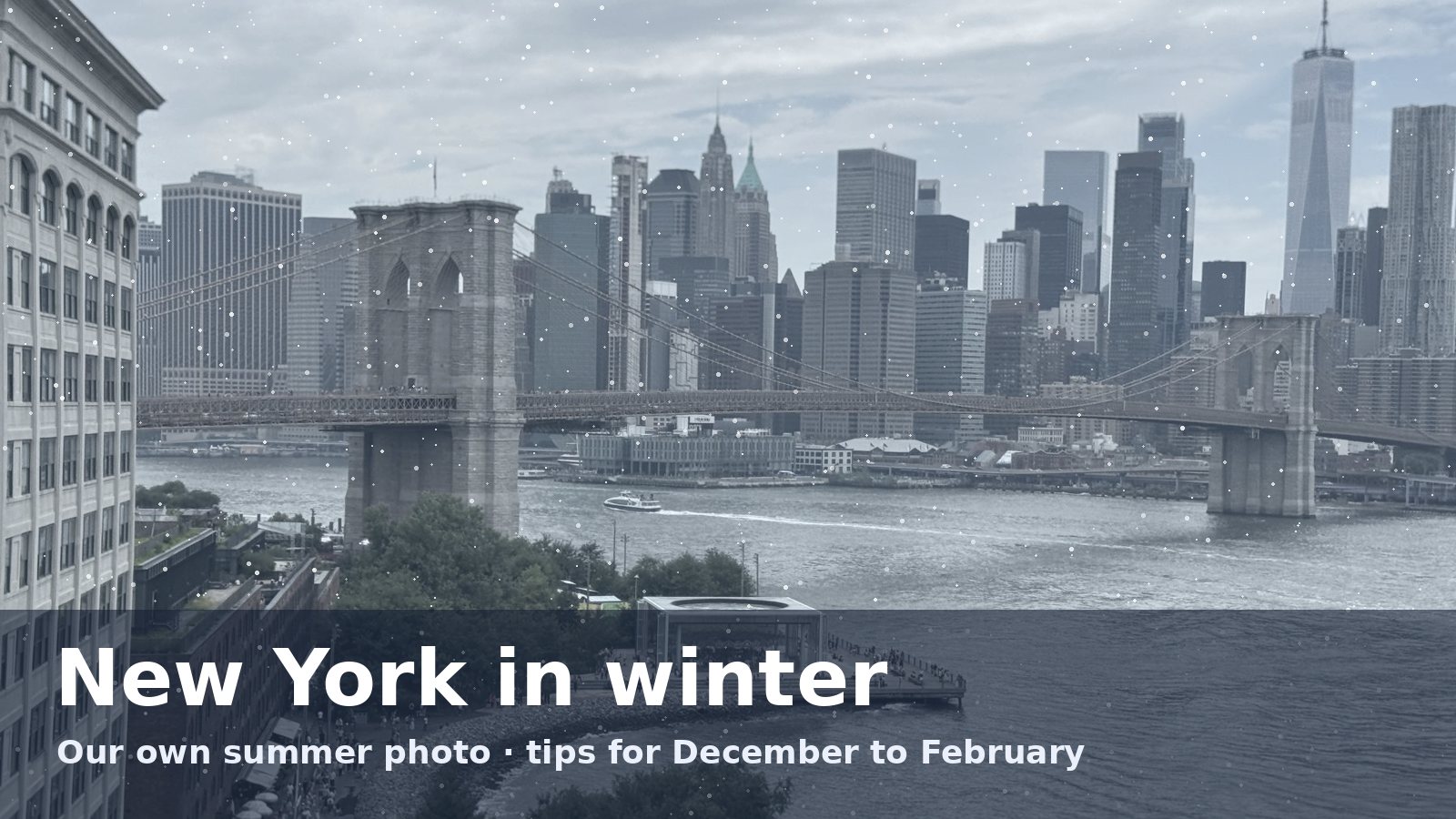
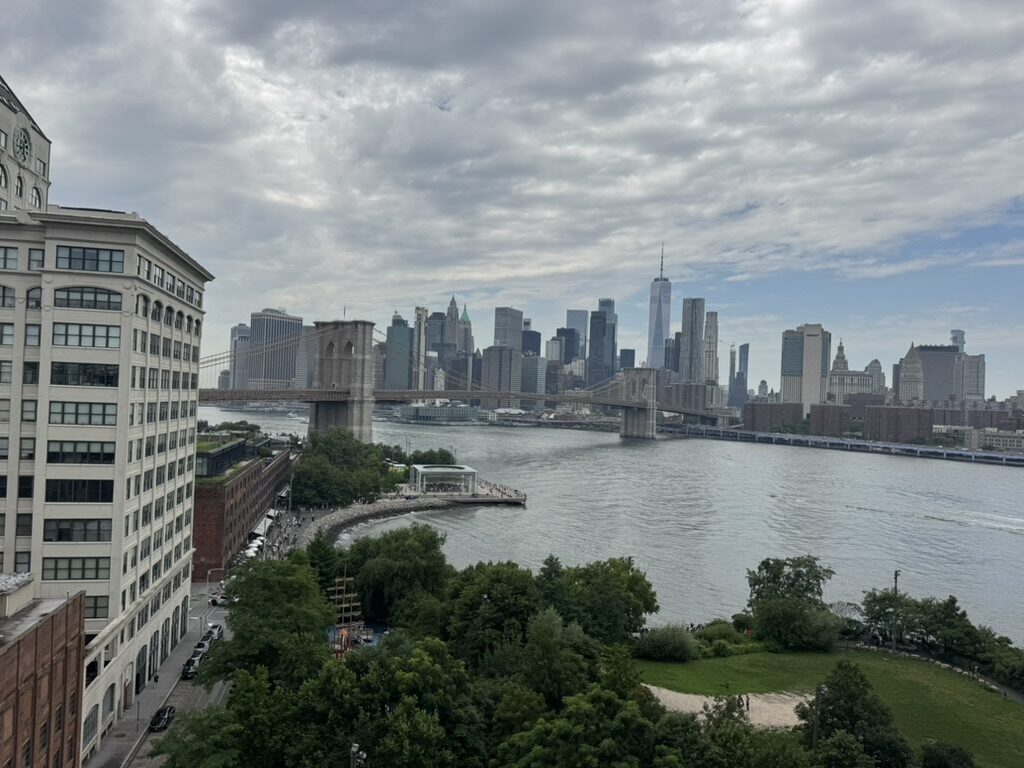
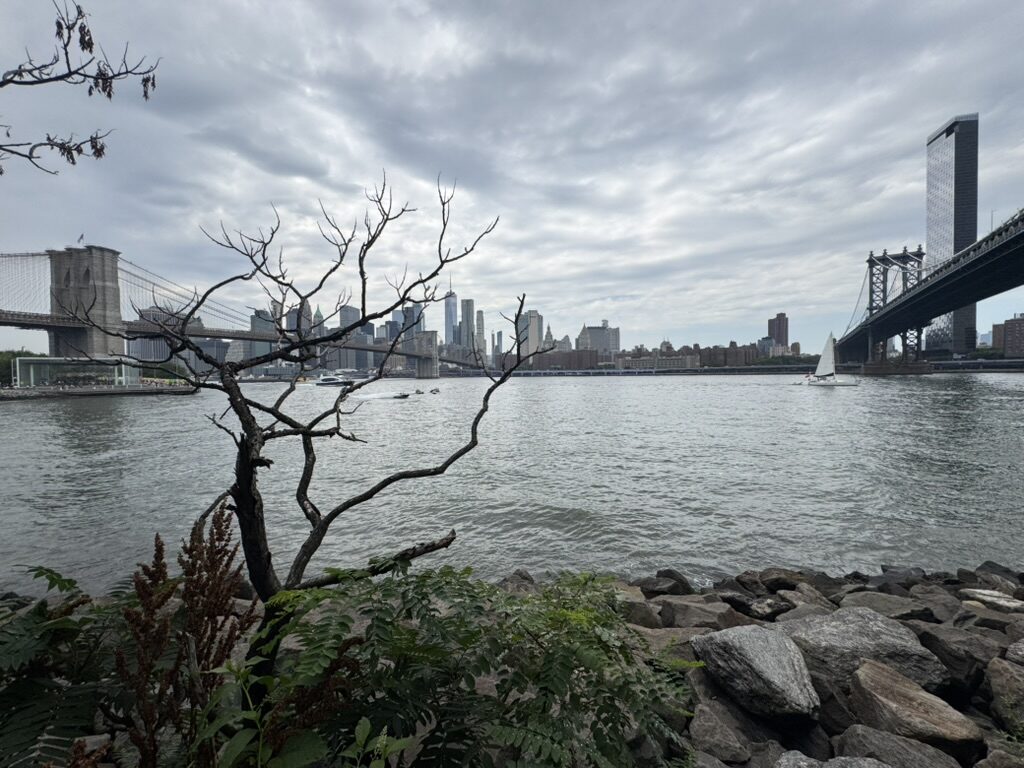
That is why we wrote this article. The photos here are our own pictures from summer – we show you the places the way we saw them. Everything about winter (dates, temperatures, prices) we researched carefully from official sources and list below with sources and the date we checked. So you get both: a feel for the city and the hard facts for planning.
New York in winter: weather, temperatures and what to wear
The honest answer first: New York in winter feels colder than the numbers suggest. The wind whistles down the avenues and blows in off the water. These are NOAA’s climate normals for Central Park (1991–2020):
Month
Avg. high
Avg. low
Avg. snowfall
December
44.3 °F ≈ 6.8 °C
33.8 °F ≈ 1.0 °C
4.9 in ≈ 12 cm
January
39.5 °F ≈ 4.2 °C
27.9 °F ≈ −2.3 °C
8.8 in ≈ 22 cm
February
42.2 °F ≈ 5.7 °C
29.5 °F ≈ −1.4 °C
10.1 in ≈ 26 cm
Source: NOAA climate normals 1991–2020, Central Park station (Belvedere Castle). Metric values rounded.
What does that mean in practice? Snow is possible, but not a promise. Statistically most snow falls in January and February, not at Christmas. If you dream of a snowy Central Park, aim for late January to mid-February – and check the National Weather Service forecast a few days before you fly.
What we would pack: a long, windproof down or winter coat, a hat, scarf, touchscreen gloves (you pay for the subway and coffee contactless), waterproof shoes with grip (the slush at crossings gets deep) and layers underneath. Museums, the subway and shops are often very warm. Layers beat your thickest sweater.
Christmas in New York: Rockefeller Center, Fifth Avenue and the lights
When people say “New York in winter”, this is usually what they mean: the giant tree above the rink at Rockefeller Center, the Fifth Avenue windows, string lights down to the last fire escape.
The Rockefeller Center Christmas tree
The tree is traditionally lit for the first time in a big televised show in late November or early December – in 2025 it was 3 December. As of our check (09.11.2026), Rockefeller Center had not yet published the official 2026 date. Our advice: skip the ceremony night itself. Streets around the plaza are closed, you stand for hours in the cold and often see little. A normal evening afterwards is far nicer – ideally early morning or late at night. According to Rockefeller Center the tree was lit daily from 5 am to midnight in 2025, so the early hours are almost yours alone.
Fifth Avenue: windows worth the walk
Between Rockefeller Center and Central Park, Fifth Avenue is lined with department stores and luxury shops that dress their windows lavishly every year. Saks Fifth Avenue sits opposite Rockefeller Center, Bergdorf Goodman further up towards the park. The windows are free and you can still see them late in the evening. Tip: walk from 49th Street to 59th Street and turn into Central Park at the end.
Dyker Heights: Brooklyn’s light madness
In Dyker Heights, a residential neighbourhood in south Brooklyn, residents decorate their homes with so many lights during Advent that people come from all over the city. It is a residential area – keep quiet, stay off front yards and take your rubbish with you. If you would rather not do the long subway ride, there are guided evening bus tours (link below).
Ice skating in New York: Bryant Park, Wollman Rink and Rockefeller Center
Skating beneath skyscrapers is one of those things you never forget. And here is the first trap: the most famous rink is not automatically the best one.
Rink
Season 2026/27
Admission
Best for
Bryant Park (Winter Village)
28 Oct 2026 – 28 Feb 2027, daily 8 am–10 pm, 19 Nov–3 Jan until midnight
Free admission, skate rental $18.72–64.48
Anyone who wants affordable skating in Midtown, with holiday market stalls around it
The postcard view: ice in front of the skyline at the south end of the park
Rockefeller Center
Winter season
Timed tickets, check prices with the operator
Skating right under the tree – small, pricey, in high demand
Sources: bryantpark.org, wollmanrinknyc.com (prices incl. tax), checked 09.11.2026. At Wollman Rink, 25 and 31 December are “prime” days.
Our recommendation: Bryant Park in the morning for kids (and the budget), Wollman Rink once in the afternoon for the big feeling, when the sun sits low over the towers on Central Park South. If you must skate at Rockefeller Center, book early and only through the operator.
Central Park in winter: Gapstow Bridge, The Pond and the quiet corners
In summer Central Park was a green oven full of joggers for us. In winter it transforms. The best way in is the south-east entrance at Fifth Avenue and 59th Street. A few steps later you reach The Pond, with the stone Gapstow Bridge arching over it and the Midtown towers behind. After snowfall it is one of the most photographed winter views in the city.
From there it is a few minutes to Wollman Rink, then north to the Mall with its elms (bare in winter, casting beautiful shadows) and on to Bethesda Terrace. For quiet, keep going to the Reservoir: a running loop, open sky, skyline in every direction.
Feeling over checklist: give yourself an hour here with no plan. A coffee in your hand, your breath in the cold air, the muffled hum of the city behind the trees. That is the moment New York suddenly goes quiet.
Our pictures from summer: the view from DUMBO to Lower Manhattan. In winter you stand in the same spot – just with a hat and far fewer people.
Brooklyn Bridge and DUMBO in winter
Our favourite place in New York is still the DUMBO waterfront. We stayed there and had the same view every evening: Brooklyn Bridge on the left, Manhattan Bridge on the right, Lower Manhattan and One World Trade across the river. In winter it gets dark earlier – and that is your advantage. When the office towers light up at half past four, you get the skyline at night without staying up late.
Our bridge tip: walk from Brooklyn to Manhattan in the early morning. In summer it was already busy at seven; in winter it is much emptier. The wooden planks can be slippery when icy – sturdy shoes are a must. Then continue on foot to the 9/11 Memorial, where the two reflecting pools are free to visit.
Times Square on New Year’s Eve: is it really worth it?
The ball drop in Times Square is free and there are no tickets – first come, first served. According to the Times Square Alliance, viewing areas open at 3 pm and the ball drops at 11:59 pm. That is almost nine hours on your feet, at temperatures around freezing.
What many people don’t know: there are no portable toilets, and if you leave your pen you usually won’t get back in. Backpacks, large bags, umbrellas, folding chairs and alcohol are banned, and all bags are searched. With kids, we honestly advise against it.
Better alternatives: the fireworks in Central Park or Prospect Park in Brooklyn, a New Year’s cruise with a view of the Statue of Liberty (only with well-reviewed operators) or simply the DUMBO waterfront – skyline, bridges and no crush.
Grand Central, museums and views: New York indoors when it’s freezing
On bitterly cold days New York is one of the best indoor cities in the world. Our favourites:
Grand Central Terminal: free to enter. Stand under the green-and-gold star ceiling of the Main Concourse, then find the Whispering Gallery outside the Oyster Bar – two people in opposite corners can hear each other whisper.
The Metropolitan Museum of Art and the American Museum of Natural History both sit on Central Park – perfect after a walk. Visitors from abroad pay fixed admission, so buy online directly from the museum.
MoMA: modern art, compact, great for half a day.
Observation decks: we did Summit One Vanderbilt in summer – the mirror rooms are unreal. In winter, clear cold days often give better visibility than hazy July. Don’t book in fog or sleet.
Several attractions on one pass? Passes like CityPASS or Go City only pay off if you really do three or four big attractions. Do the maths first and buy only where cancellation terms are fair.
Traps in New York in winter – and how to avoid them
This is where most travellers save real money – or lose it:
The “ESTA” from a middleman. It happened to us: the site looked official and we paid an agency many times the government fee. The official ESTA fee has been USD 40.62 per person since 16.10.2026 (sources below). How to tell: the real site ends in .gov. Anything with “esta-usa”, “-online” or “visa-service” on a .com address is an agency. The direct route to the right site – with a QR code and step-by-step instructions – is in our guide.
Taxi touts at the airport. At JFK men approach you in arrivals: “Taxi? Limo?” – never go with them. Queue only at the official taxi stand. From JFK to Manhattan there is a $70 flat fare plus, according to the NYC Taxi & Limousine Commission, surcharges ($0.50 MTA, $1.00 improvement, $2.50 congestion, $0.75 for entering the congestion zone south of 60th Street, $5 rush hour on weekdays 4–8 pm), tolls and tip.
The cheap way from the airport: AirTrain JFK ($8.75) to Jamaica, then the subway ($3.00). Takes longer, costs a fraction.
Hotels over New Year. The week between Christmas and New Year is the priciest of the year. If you are flexible, travel in early December or from the second week of January – prices drop noticeably.
Taxes and fees. New York hotel prices are often shown without taxes and fees. Always compare the final price.
Ticket resellers. Buy tickets for observation decks, rinks and shows from the operator or well-known platforms with free cancellation – never from street sellers in Times Square.
Paying in euros. If the card terminal asks “USD or EUR?”, always choose USD. Otherwise the merchant’s bank converts at a poor rate.
Our New York guide is coming soon – sign up to be notified. Inside: the direct route to the official ESTA site with a QR code and every step, the government fee and the typical traps, plus our route with Brooklyn as a base, the cheapest ways from the airport and every booking path with the original provider instead of a middleman. We overpaid at an agency ourselves – that is exactly why this guide exists. Sign up here and we’ll let you know when it’s out (no purchase, just one email when the guide is published).
New York in winter with kids
New York in winter works well with children if you adjust the pace. Short distances, lots of warm breaks. Skating in Bryant Park (helmets are free to borrow), the dinosaurs at the Natural History Museum, The Pond in Central Park, the holiday windows in the early evening. New Year’s Eve in Times Square, on the other hand, is not a good idea with kids. Plan one big highlight per day and leave room for a spontaneous hot chocolate.
Where to stay in New York in winter
We stayed in Brooklyn in summer and would do it again in winter. DUMBO and Brooklyn Heights are only a few subway stops from Manhattan, quieter and often cheaper than Midtown. If you want to walk to the tree, Fifth Avenue and Bryant Park every evening during Advent, Midtown between 40th and 59th Street is most convenient – but you pay for it. Either way, book hotels with free cancellation: a snowstorm can move flights.
Our picks for New York in winter (Advertising – we earn a small commission, your price stays the same)
Tours & tickets: Dyker Heights lights tours, observation decks, New Year’s cruises and passes on GetYourGuide – with reviews and usually free cancellation up to 24 hours before.
Stay: hotels in Manhattan and Brooklyn with free cancellation on Booking.com or a family apartment on Airbnb.
Money: pay and withdraw in dollars at the real exchange rate with Wise.
Insurance: medical costs in the US are extremely high – travel medical insurance belongs in your plan, flexibly for example with SafetyWing.
E-passport for every traveller, expiry date checked
ESTA applied for only on the real .gov site, USD 40.62 per person, at least 72 hours before departure
Hotel or apartment with free cancellation
2026 tree-lighting date checked with Rockefeller Center shortly before the trip
Skating: Bryant Park (free) or Wollman Rink (ticket online in advance)
Windproof coat, hat, scarf, touchscreen gloves, waterproof shoes
Contactless card or phone wallet for the subway (OMNY)
Wise or another multi-currency card – always choose USD at the terminal
Travel medical insurance in place
National Weather Service forecast checked in the last days before the flight
FAQ: New York in winter
Safety
How cold is New York in winter?
According to NOAA normals for 1991–2020, the average daytime high in Central Park is about 44 °F (7 °C) in December, 40 °F (4 °C) in January and 42 °F (6 °C) in February. Nights in January and February average just below freezing. Wind makes it feel much colder.
Tip
Does it snow in New York at Christmas?
It can, but don’t count on it. December averages about 4.9 inches (12 cm) of snow, January 8.8 inches (22 cm) and February 10.1 inches (26 cm). Your best snow chances are mid-January to late February.
Timing
When is the 2026 Rockefeller Center tree lighting?
Traditionally in late November or early December – in 2025 it was 3 December. Rockefeller Center publishes the official 2026 date; as of our check (09.11.2026) it had not been announced.
Tip
Where can you ice skate for free in New York?
In Bryant Park. Admission to the rink is free; you only pay if you rent skates. The 2026/27 season runs from 28 October 2026 to 28 February 2027.
Tip
Is New Year’s Eve in Times Square worth it?
Only for the very hardy. It is free, but you stand in the cold from the afternoon until midnight, with no toilets and no backpack. Fireworks in Central Park or Prospect Park are far more relaxed.
Costs
How much is a taxi from JFK to Manhattan?
A $70 flat fare plus surcharges, tolls and tip. On weekdays between 4 and 8 pm a $5 rush-hour surcharge is added. Cheaper: AirTrain ($8.75) plus subway ($3.00).
Costs
How much does the ESTA cost?
The government fee has been USD 40.62 per person since 16.10.2026. The real site ends in .gov – agencies often charge many times more. The direct route with a QR code is in our guide.
Tip
Is December or January better for New York?
December for the Christmas atmosphere, lights and the tree. January and February for fewer crowds, better snow chances and usually cheaper hotels.
New York in winter is not a stand-in for summer – it is a different city. Quieter in Central Park, brighter on Fifth Avenue, more honest in the early hours on the Brooklyn Bridge. We have experienced New York in summer and we know: these places carry you. Pack warm, book everything with the original provider and treat yourself to one evening on the DUMBO waterfront when the lights come on. Read more about our own trip in New York in July – Brooklyn Bridge, DUMBO and Summit One Vanderbilt. All destinations are on our homepage, and the PDF guides under Guides.
Sources (checked 09.11.2026)
NOAA / National Weather Service: climate normals 1991–2020, Central Park (temperature, snowfall)
Rockefeller Center: magazine articles on the tree and the 2025 lighting (rockefellercenter.com)
Bryant Park Corporation: The Rink, 2026/27 season (bryantpark.org)
Wollman Rink: 2026/27 season and prices (wollmanrinknyc.com)
Times Square Alliance: New Year’s Eve FAQ (timessquarenyc.org)
NYC Taxi & Limousine Commission: taxi fare (nyc.gov/tlc)
Port Authority NY/NJ: AirTrain JFK (jfkairport.com)
ESTA fee USD 40.62 from 16.10.2026: reports by buch-dein-visum.de and VisasNews (October 2026) on the fee adjustment by U.S. Customs and Border Protection
Prices, dates and rules can change – check with the official sources above before you travel.
Plan this tripOur go-to links for a place to stay, rental cars, mobile data and travel gear:
Bangkok rainy season May–October: wettest month September (336 mm), usually 1–2 h of afternoon rain. Climate table, day plan, transport, den…
10 Nov 2026 · 12 min read
Let me know when the guide is out
🔔 Get new articles & deals as a notification?No spam – max. 4 a day, switch off anytime.
Your choice
We only use what is necessary to run this website. Everything else – such as statistics or content from third parties – only with your consent. You can change your choice at any time.